
This article presents two case number comparison charts for the 9th March and 23rd March 2020 UK Coronavirus lockdown dates. I had covered the deaths data in more detail in my previous post on this topic, and add that here too.
Category Archives: Multiple variants
My Coronavirus UK model outcomes as ONS reporting comes to an end

The UK Office of National Statistics (ONS) had just announced that it was ceasing publication of the regular cases and deaths outcomes of the UK Covid-19 pandemic, as of 24th March 2023, and then revised all previously published Covid data. I was able to make global changes to most of my model history, by re-working some of the early Variant characteristics in the model. This post reports the outcomes of that work.
Official UK Coronavirus reporting ends

Introduction I have continued to run my own Coronavirus model, my recent prior report on February 9th this year having immediately followed the outbreak of the “Kraken” variant, Omicron XBB.1.5, in the UK. This brief post provides my own latest charts from my model, in the light of cessation of the UK Government’s own CovidContinue reading “Official UK Coronavirus reporting ends”
The Kraken Wakes* – Coronavirus
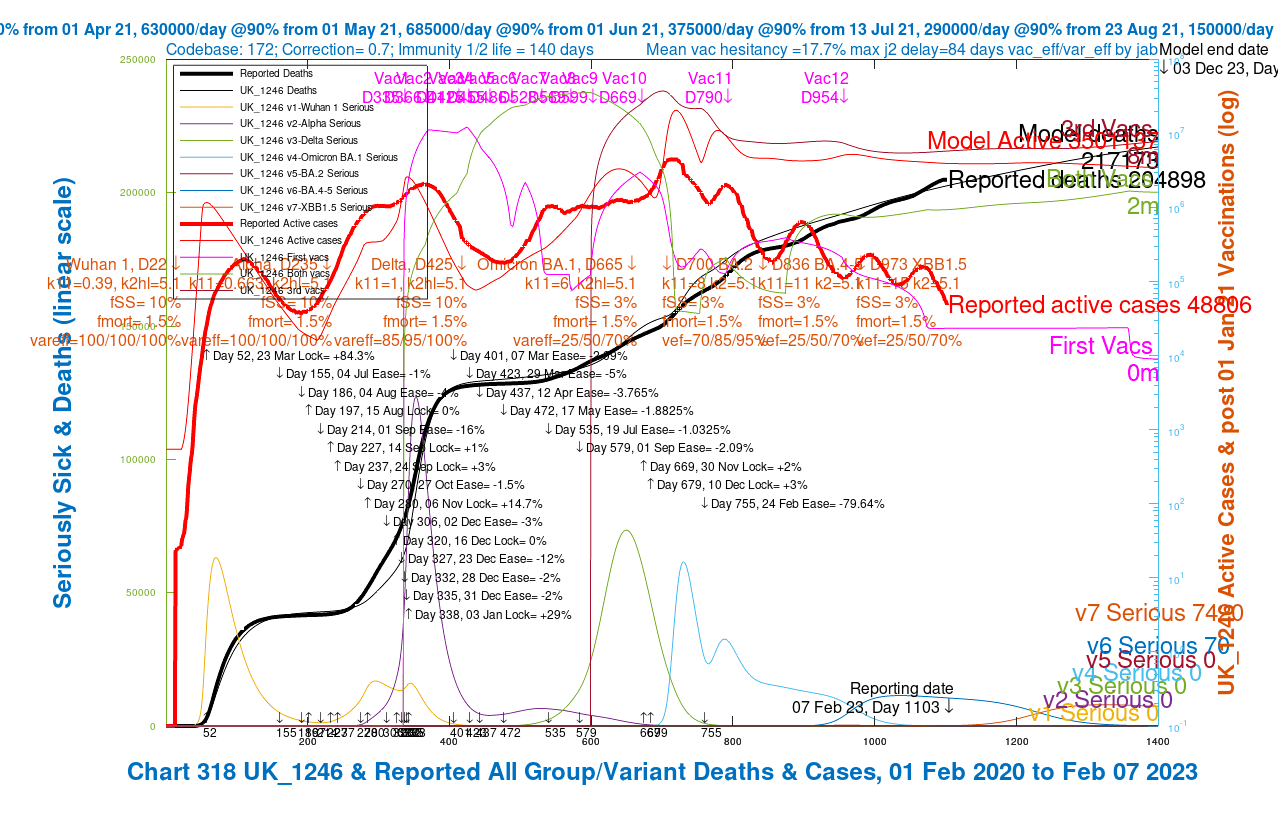
I have continued to improve and run my Coronavirus model daily. The code for the model is now at version 172, and I have added a dataset to represent the variant XBB.1.5, known informally as “Kraken”. The fit of the model to reported deaths is good. I explore in the article the behaviour of Modelled vs. Reported Active Cases.
Declining Omicron cases but increasing deaths – Coronavirus

Something odd seems to be happening with the relationship between reported UK Covid-19 cases and deaths in the last few weeks, when deaths have been increasing somewhat more quickly than recently, but cases have declined steeply. My model charts seem to expose this oddity.
A first 2022 Omicron update – Coronavirus

While it is still very early days, both in the New Year of 2022 and also for the Omicron variant, this post adds to my recent 19th December update with a summary of further runs of my model for higher transmissions settings. Last time I ran options up to three times the transmission rate of the Delta variant, and I have now looked at transmission up to five times the Delta rate.
Omicron modelling update – Coronavirus

I have run updates to my model for lower and medium vaccine efficacy to Omicron, and lower, medium and higher virulence and mortality, and continue to compare with reported data. While evidence is still in short supply, nothing has firmly contradicted the impression that Omicron is highly transmissive, as well as being possibly less virulent.
Just as we thought it was safe to go back into the water – Coronavirus
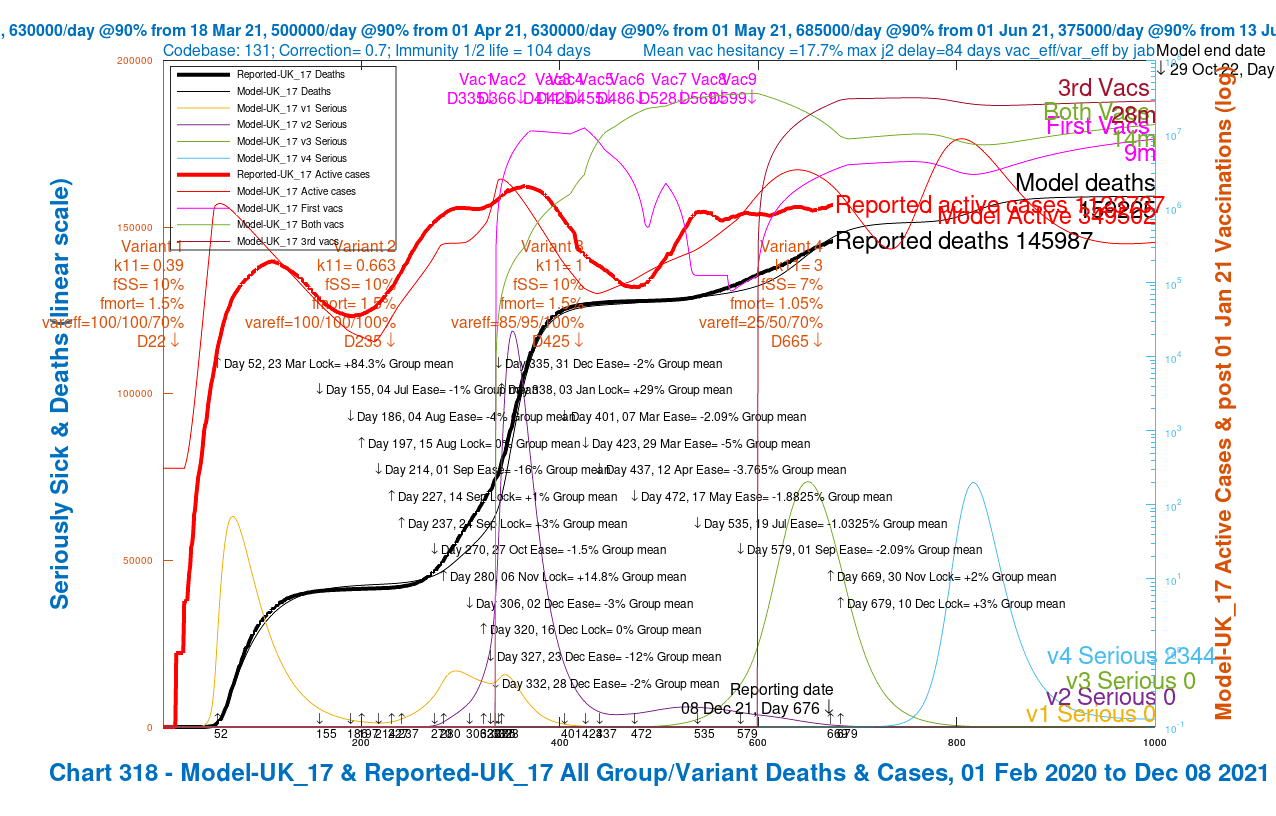
Omicron is feared to have higher infectiousness than the Delta variant, with even greater concerns should it turn out to cause more severe symptoms, higher mortality, and possibly worst of all, if it were able to evade current Covid-19 vaccines. I have made some parametric runs of my model to assess the possible effects.
The Coronavirus pandemic situation in Europe
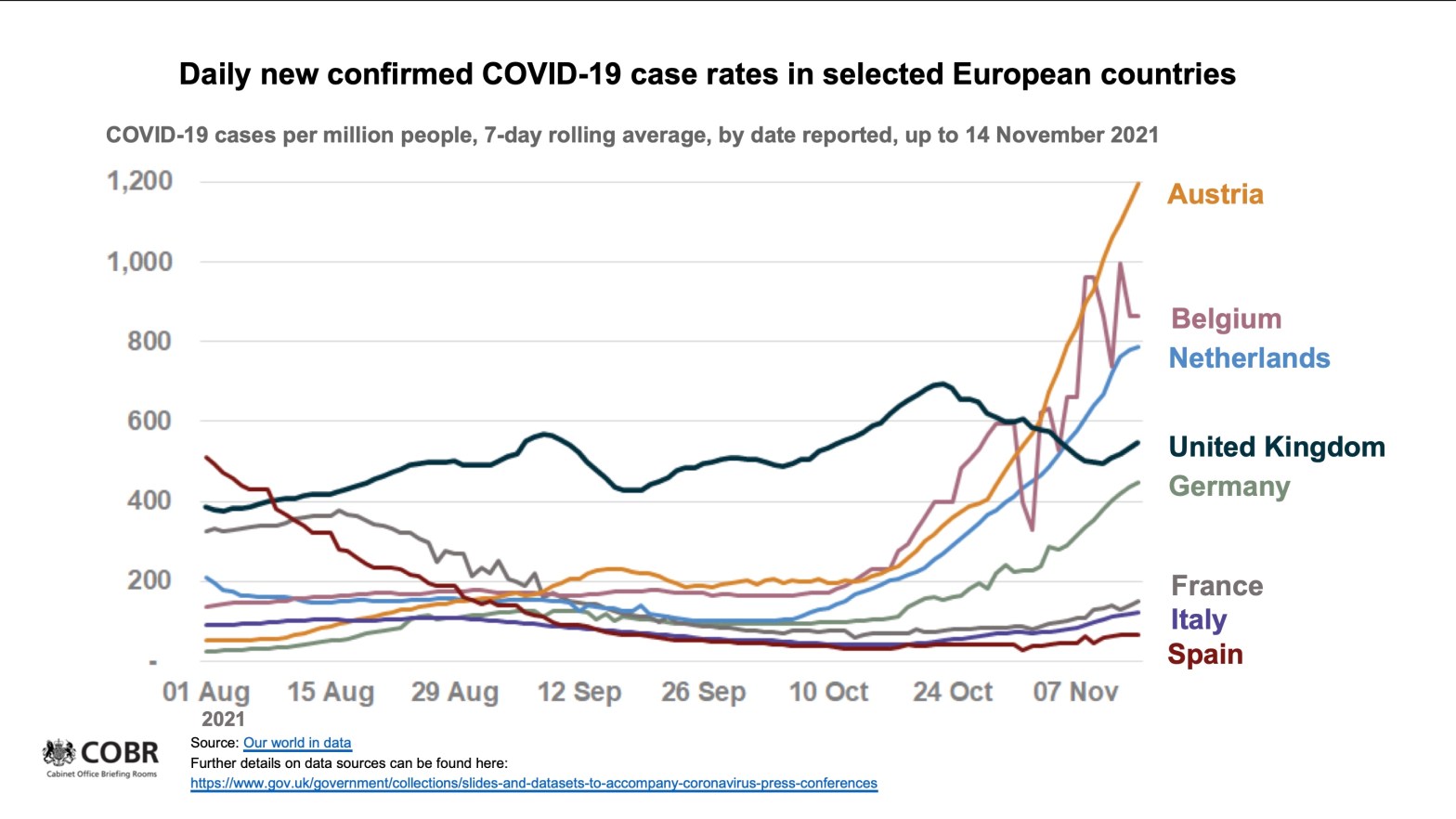
The pandemic situation in continental Europe has been worsening rapidly, and I felt that it I should update some country comparisons in a dedicated post.It confirms that the sourcing of data for a Coronavirus model of any given country is a very specific task nowadays, given the considerable differences in the underlying demographics, cultures, Government actions (NPIs) and public responses in the various countries.
This blog post isn’t looking at the modelling per se, but concentrates on the very different outcomes we are seeing across Europe, and looking at some of the reasons why.
Coronavirus pandemic modelling review

Vaccination has somewhat stabilised the SARS-Cov-2 pandemic in the UK. I summarise the capabilities that I have found necessary and useful in modelling the behaviour of the pandemic; successive variants, different population age-groups, the effect of Government NPIs, and vaccinations.
 A rambling mind