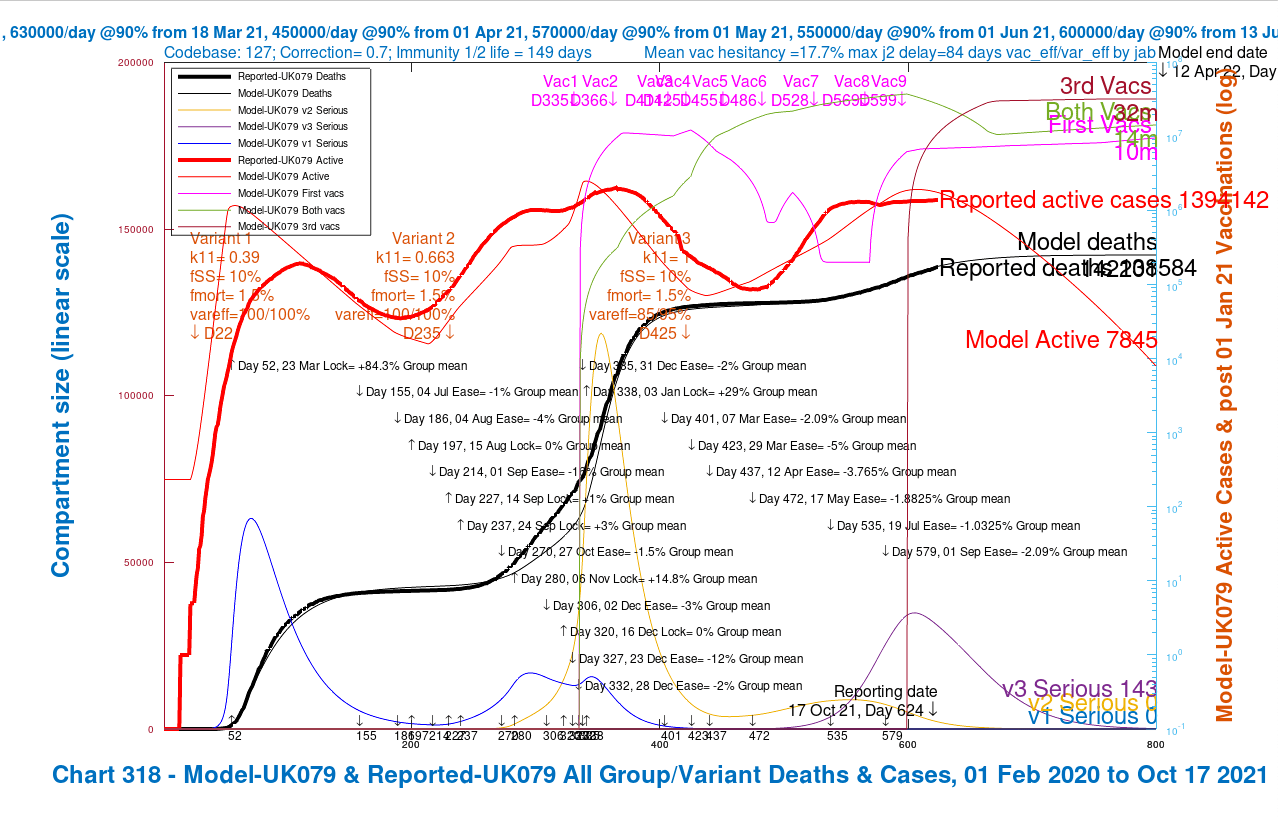
Having just had my 3rd Covid jab, the “booster” jab, it provoked a few thoughts about that, my Coronavirus model, and the wider scene. I had incorporated multiple jabs into my UK model some time ago, and multiple phases for inoculation volumes to cope with the first and second jabs. I am taking this opportunity to report briefly on model outcomes for waning immunity in the context of booster jabs.
Category Archives: New Variant Coronavirus
“Freedom Day”, multiple vaccinations and the Coronavirus Delta variant
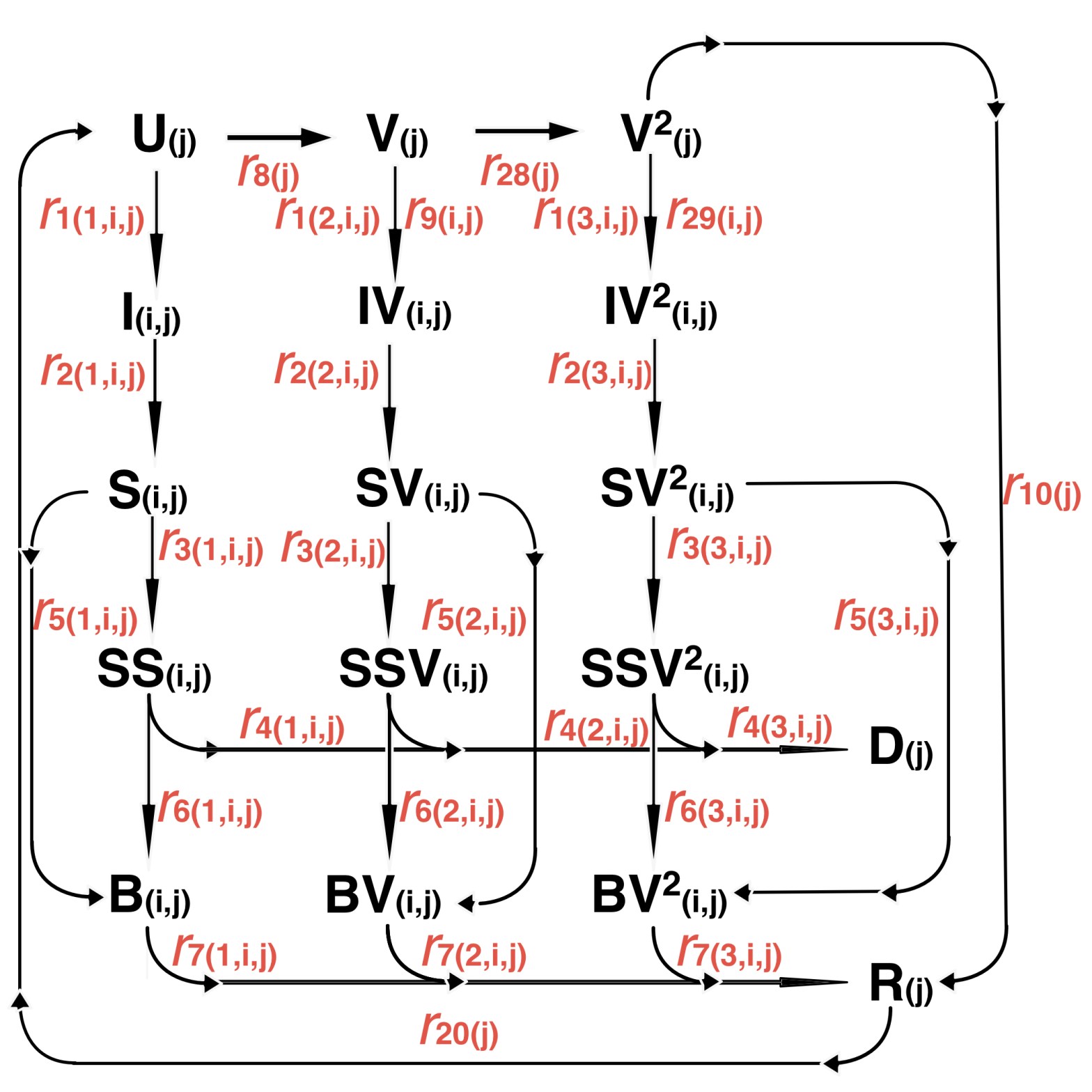
In this post, I run a development of my model which includes immunity waning (at a 150 day half-life), vaccine hesitancy by group, multiple vaccine inoculations (representing the typical two jabs required by most vaccines for best immunity) and also the possibility of vaccinated people not only to become infected, but also to pass on the virus even if not infected themselves.
Coronavirus Delta variant impact on June 21st easing – delay or reduce?
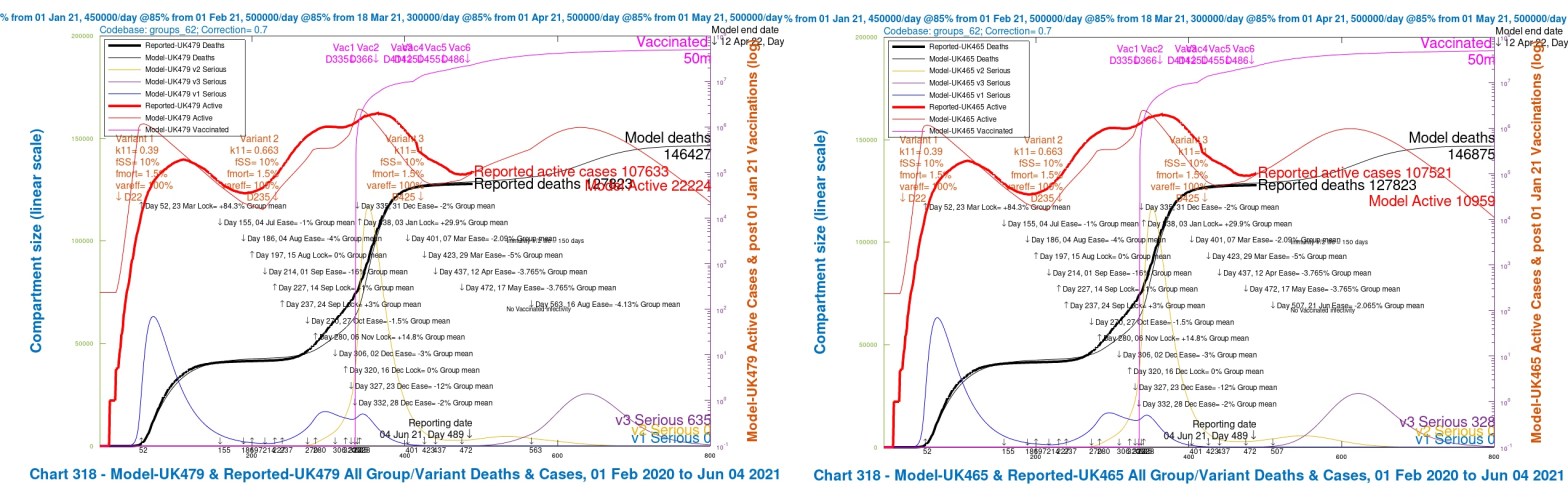
Having explored what pandemic advisers might be seeing and highlighting to decision-makers in Government, I run scenarios with different settings for the planned June 21st relaxation of lockdown, the last in the series of relaxations over the first half of 2021, following the January 3rd lockdown. These model scenarios show examples of what the relative consequences of the June 21st relaxation as planned, versus four other options:- cancellation of the June 21st step altogether, two different delays, of 28 and 56 days, and lastly a 50% reduction in the scope of the June 21st relaxation.
What are UK Government Coronavirus advisers seeing?

I have developed some model scenarios that show examples of what might be behind expert advice on the caution required with new SARS-Cov-2 variants. The scenarios indicate the importance of the UK vaccine programme, as we face variants with potentially different characteristics of transmission, severity of infection and responsiveness to vaccines. Understanding those variant characteristics is vital for projections.
Why the UK Government is worried about new Coronavirus variants

I have developed some model scenarios that show examples of what might be behind expert advice on the caution required with new SARS-Cov-2 variants. The scenarios indicate the importance of the UK vaccine programme, as we face variants with potentially different characteristics of transmission, severity of infection and responsiveness to vaccines.
Exploring new Coronavirus variants, vaccines and NPIs
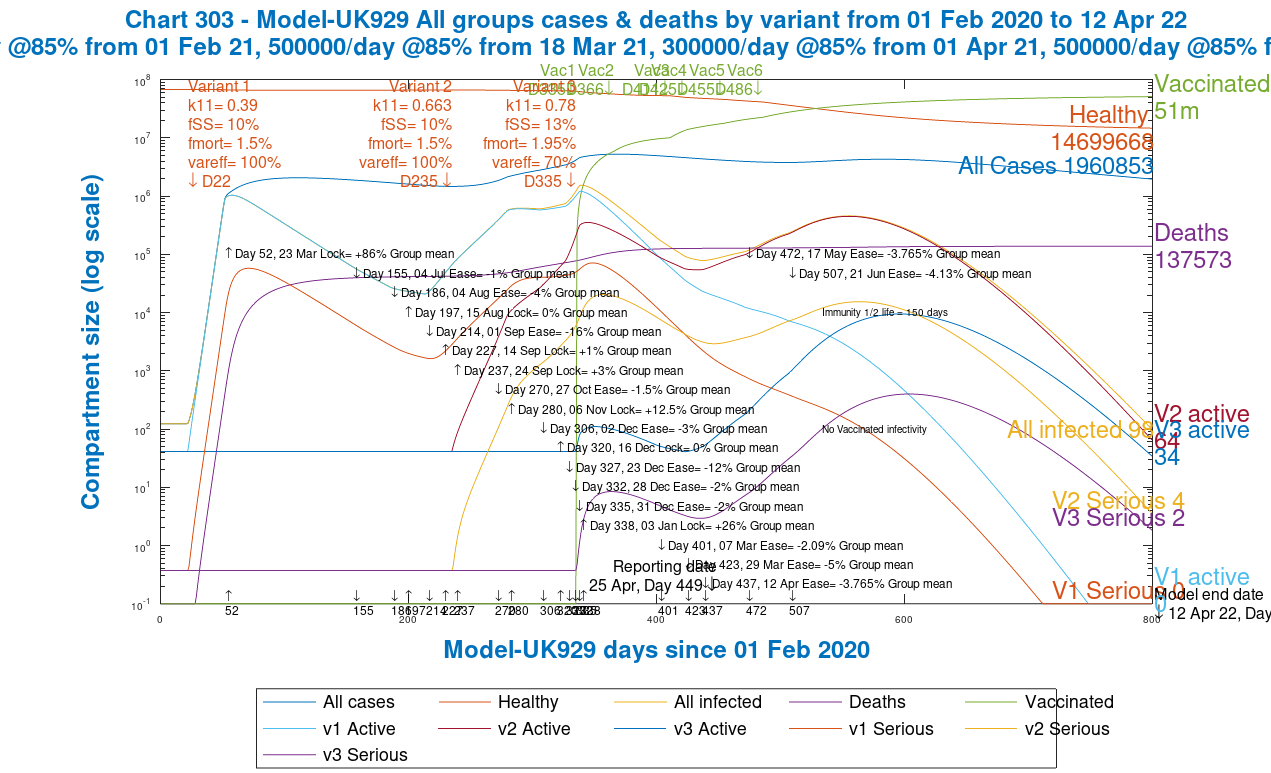
There has been increasing concern recently about SARS-Cov-2 variants that might escape vaccines to some extent, as well as having different transmission rates (as the Kent variant does), and causing different severity of illness with higher mortality. I have added a vaccination efficacy modifier, var_eff, by variant, as a multiplier to the standard vaccination efficacy, vac_eff, to help model such potential variants that have a partial or total capability to escape vaccines, and this post shows examples of how that works, using a third variant introduced to the model on January 1st 2021. In addition, I have completed adding fSS (the fraction of people becoming seriously sick from each variant) and fmort (fatality of the variant) by Covid variant.
Tuning the age and vulnerability Coronavirus model

In my latest post on March 26th I described a new Coronavirus group model, based on work I had done as a UK case study in support of Prof. Alex de Visscher’s paper, in conjunction with Dr. Tom Sutton, on “Second-wave Dynamics of COVID-19: Impact of Behavioral Changes, Immunity Loss, New Strains, and Vaccination” which has now been published for peer review as a pre-print on Springer’s site at https://www.researchsquare.com/article/rs-195879/v1. I have now added the latest UK vaccination progress figures, and the UK Government’s announced intentions for the near future regarding Non Pharmaceutical Interventions (NPIs). I have also updated mortality and infection characteristics for the four different population groups in the model.
Age and vulnerability related Coronavirus modelling

In my most recent post on February 12th, I described modelling work I had done in support of Prof. Alex de Visscher’s paper, in conjunction with Dr. Tom Sutton, on “Second-wave Dynamics of COVID-19: Impact of Behavioral Changes, Immunity Loss, New Strains, and Vaccination” which has now been published for peer review as a pre-print on Springer’s site at https://www.researchsquare.com/article/rs-195879/v1. I have now added vaccination and multiple variants I had already added to our previous model into the new grouped population model, and this blog post reports on progress with that new model.
NPIs, Coronavirus variants and vaccine models

This paper reports some parametric Coronavirus model runs I have made that compare, in particular, how the UK vaccine programme allows some NPI relaxation compared with a case with no vaccination. The outcome is that the vaccine programme in the UK has the potential to reduce the imposition of NPIs on March 7th by about 15%, without costing lives, this being the next time we in the UK are due for a major NPI review, potentially involving the return of schools at around March 7th.
The timing of multiple Coronavirus variants
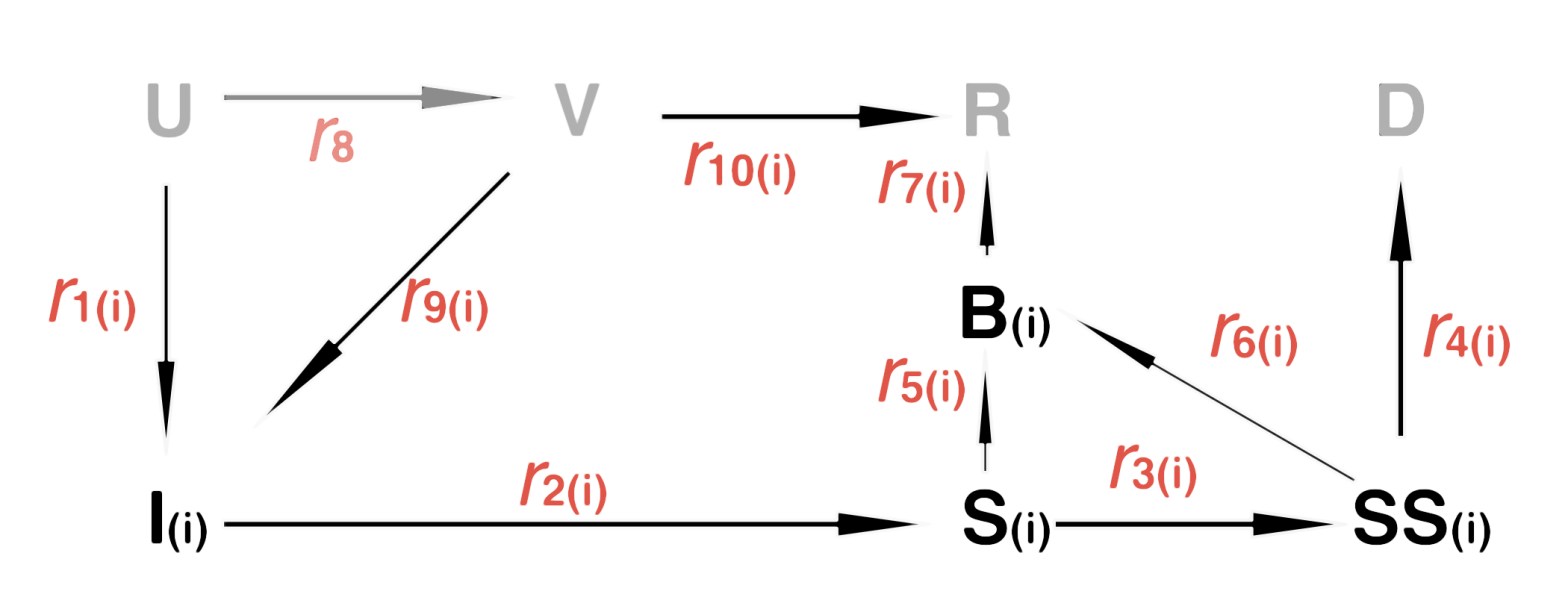
Since my most recent posts on December 23rd and January 5th I have adjusted my model algorithms to model more than two variants, so that once better data is available on new variant characteristics, I can respond more quickly. The scenarios I have modelled show that presented with the threat of new variants, early proactive, preventative and decisive action in necessary as soon as a variant is identified. If a new variant is allowed to multiply and grow before appropriate Non Pharmaceutical Interventions are introduced (just as in the first days of the UK pandemic in March 2020, and with our UK March 23rd response) control of the virus is quickly lost.
 A rambling mind