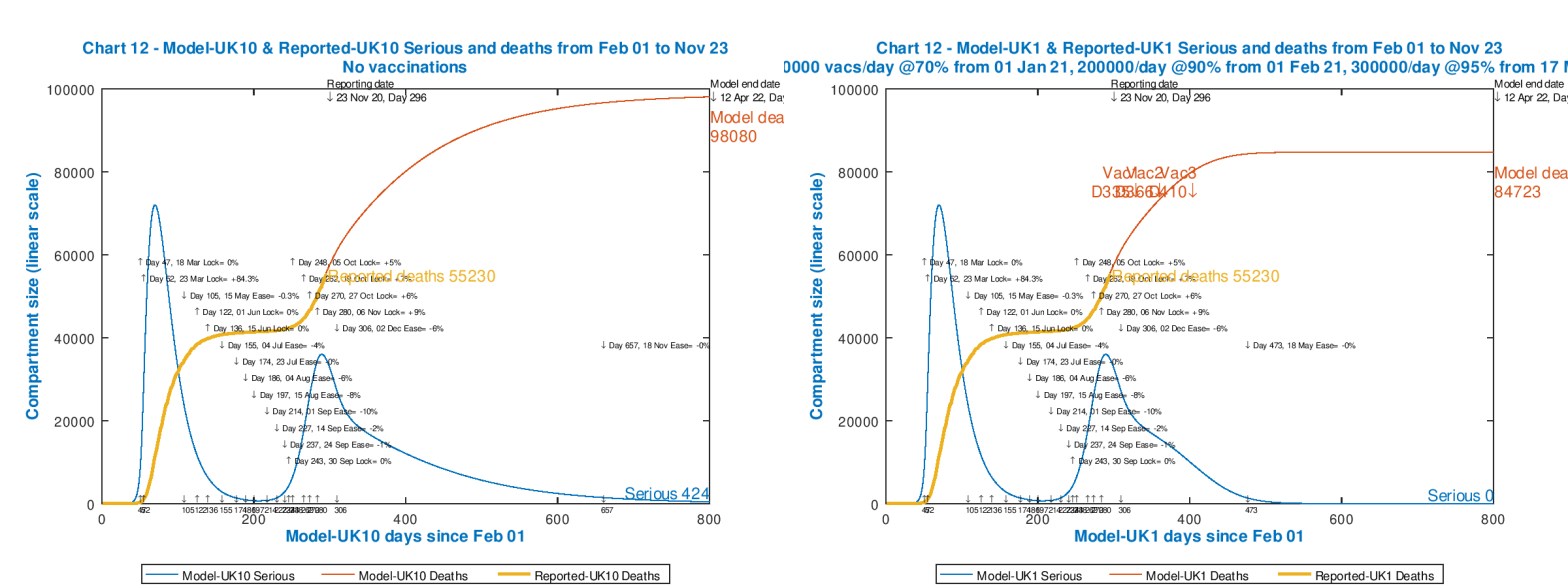
In my most recent post on November 18th, about updating my Coronavirus model to handle the impact of vaccines, I gave some examples of how case numbers, and more specifically death rates might be improved for the UK through a vaccination programme. Now that there seem to be several vaccines imminent, with efficacies ranging from 70% (Astra-Zeneca/Oxford) through 90% (A-Z/O via a different inoculation regime, and Pfizer), to 95% (Moderna) and several others in the mix, I explore some sensitivities in more detail, and also apply the model to the USA.
Category Archives: Covid-19
Vaccine, vaccine, vaccine, vaciiiine,…(don’t refuse it, just because you can) Coronavirus

In the news today, I read that Dolly Parton had given $1,000,000, through her Covid-19 Research Fund, to help fund the Moderna vaccine development. As The Times newspaper reported, this – erm – somewhat trumps the White House contribution to public safety. In her honour, Ryan Cordell composed and performed this ditty. The timing neatly coincides with the work I have been doing to incorporate vaccination into my Coronavirus model, and to that end I have been researching ways of modelling vaccination. I have made some appropriate changes, and run some model options for different vaccine efficacy; vaccinations per day; and date of starting the vaccination programme.
Make America well again – Coronavirus

I look at the impact of a postulated change in the timing of further measures to control the Covid-19 epidemic in the USA, against a current background of rapidly increasing daily case numbers and deaths. I also show an updated projection for the UK, both compared with Worldometers forecasts
Adaptive triggering and the Coronavirus epidemic life-cycle

Introduction In my last post on October 21st, looking at the potential for an exit from the epidemic, I described a cyclical version of the modelling of the epidemic in the UK, reflecting outputs from Imperial College and Harvard earlier this year, which postulated a continuing cycle of partial lockdowns, easing of restrictions and upsurgesContinue reading “Adaptive triggering and the Coronavirus epidemic life-cycle”
Where’s the exit? – Coronavirus

My title for this post is drawn from a slide I have shown before, from the 17th April Cambridge Conversation webinar, which I reported in my April 17th blog post, and also in my April 22nd blog post on model refinement, illustrating the cyclical behavior of the Covid-19 epidemic in the absence of pharmaceutical interventions, with control of cases and deaths achieved, only to some extent, by Non-Pharmaceutical Interventions (NPIs).
Recent events and Coronavirus model update

Many countries, including the UK, are experiencing a resurgence of Covid-19 cases recently, although, thankfully, with a much lower death rate. I have run several iterations of my model in the meantime, introducing several lockdown adjustment points, since my last blog post, as the situation has developed. The key feature is the sharp rise cases, and to a lesser extent, deaths, around the time of the lockdown easing in the summer. I have applied a 10% increase in current intervention effectiveness on October 19th (although there are some differences in the half-term dates across the UK), followed by a partial relaxation after 2 weeks, -5%, reducing the circuit-breaker measure by half – so not back to the level we are at currently. The effect of that change is shown in the final chart in the blog post.
A brief look at Coronavirus model sensitivities to lockdown easing as we prepare for winter

The UK Government has just announced some reversals of the current lockdown easing, and so before I model the additional interventions announced today, I want to illustrate quickly the behaviour of the model in response to changing the effectiveness of current interventions, refecting the easings that have already been made, and also to highlight the sensitivity of the forecasts of case and death rates to the influence of lockdown effectiveness.
SARS-Cov-2 modelling situation report – Coronavirus
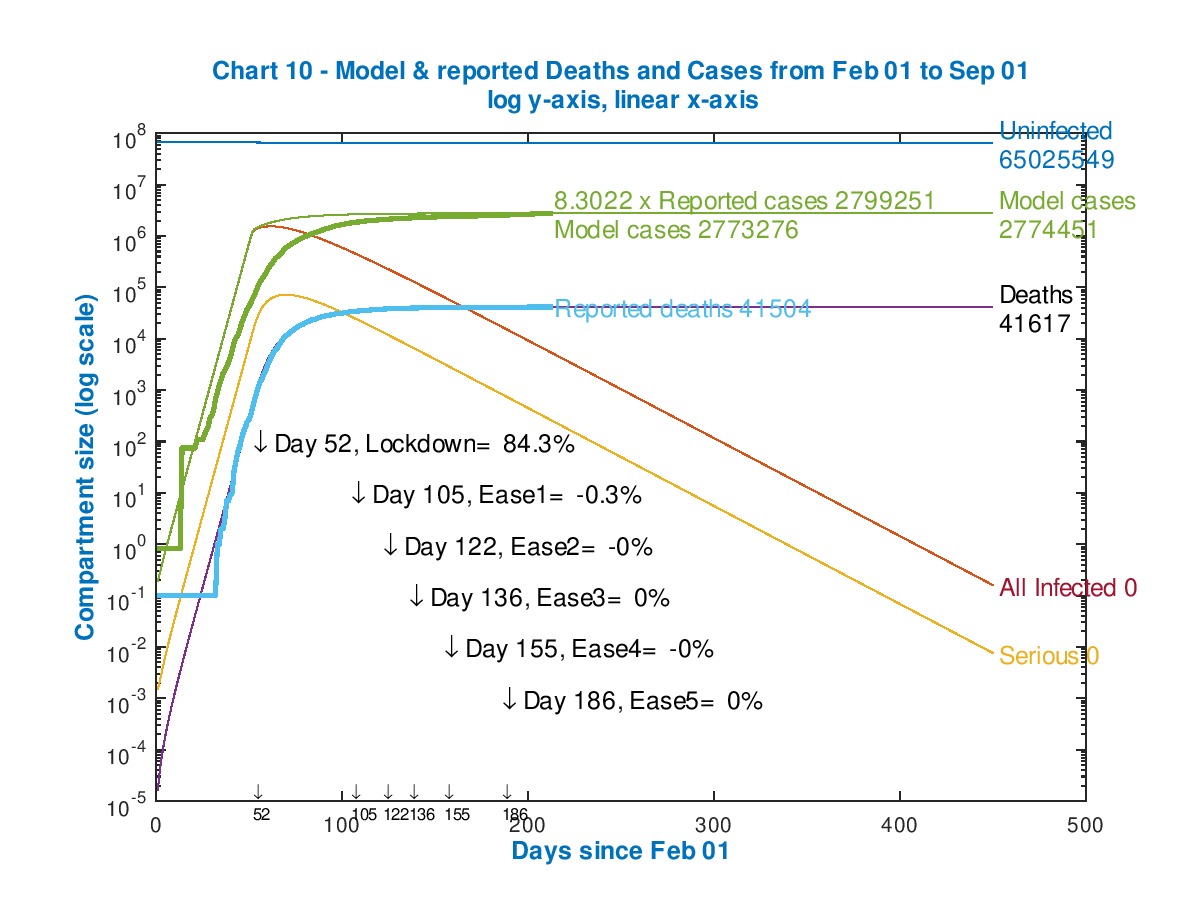
As we start September, the UK situation regarding Covid-19 cases and deaths has changed somewhat.
Since the UK Government re-assessed the way deaths data is collected and reported, the reported daily deaths resulting from Covid-19 infections have (thankfully) reduced to a very low level.
Cases, however, have started to rise again, although for a number of reasons the impact on deaths has been less than before. I have integrated the real world reported data with my model data to assess what is happening.
Coronavirus model update following UK revision of Covid-19 deaths reporting
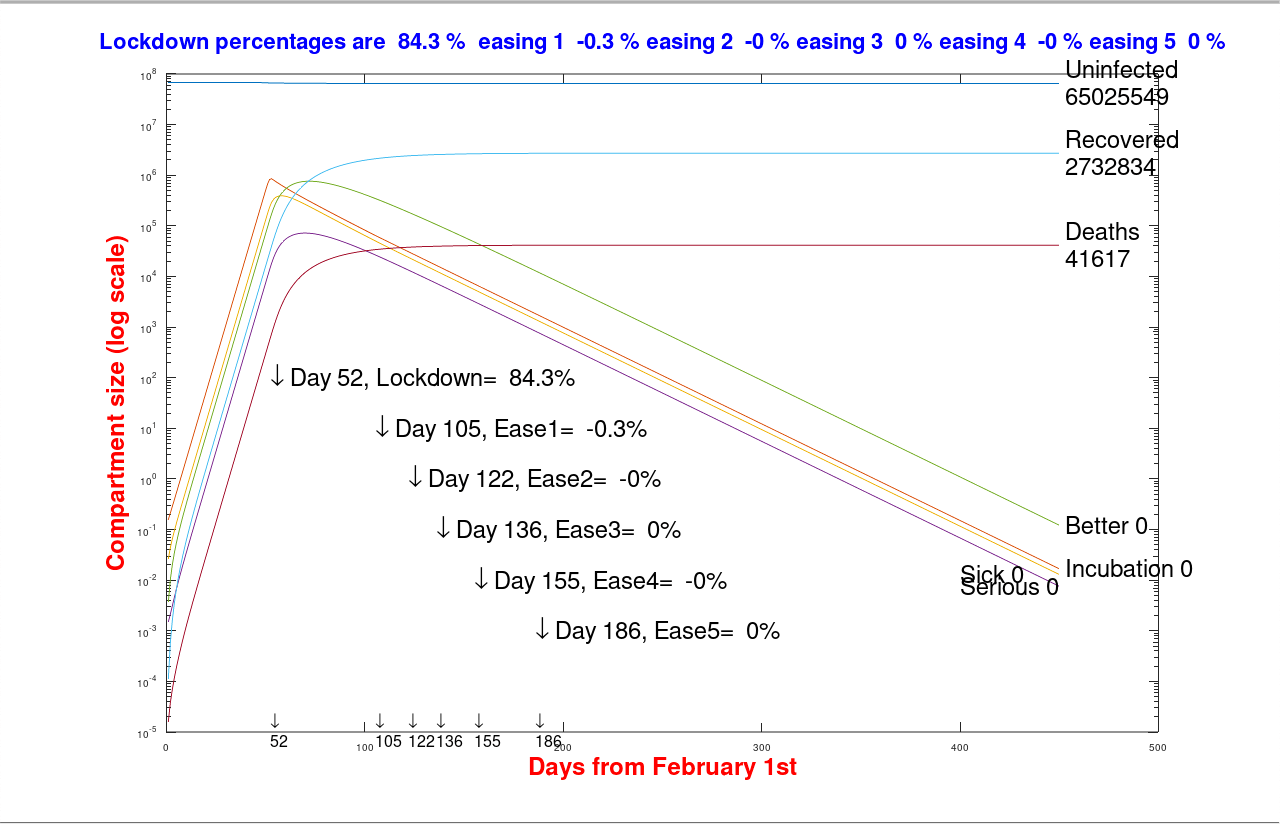
On August 12th, the UK Government revised their counting methodology and reporting of deaths from Covid-19, bringing Public Health England’s reporting into line with that from the other home countries, Wales, Northern Ireland and Scotland. I have re-calibrated and re-forecast my model to adapt to this new basis.
Coronavirus model updates for UK lockdown easing points
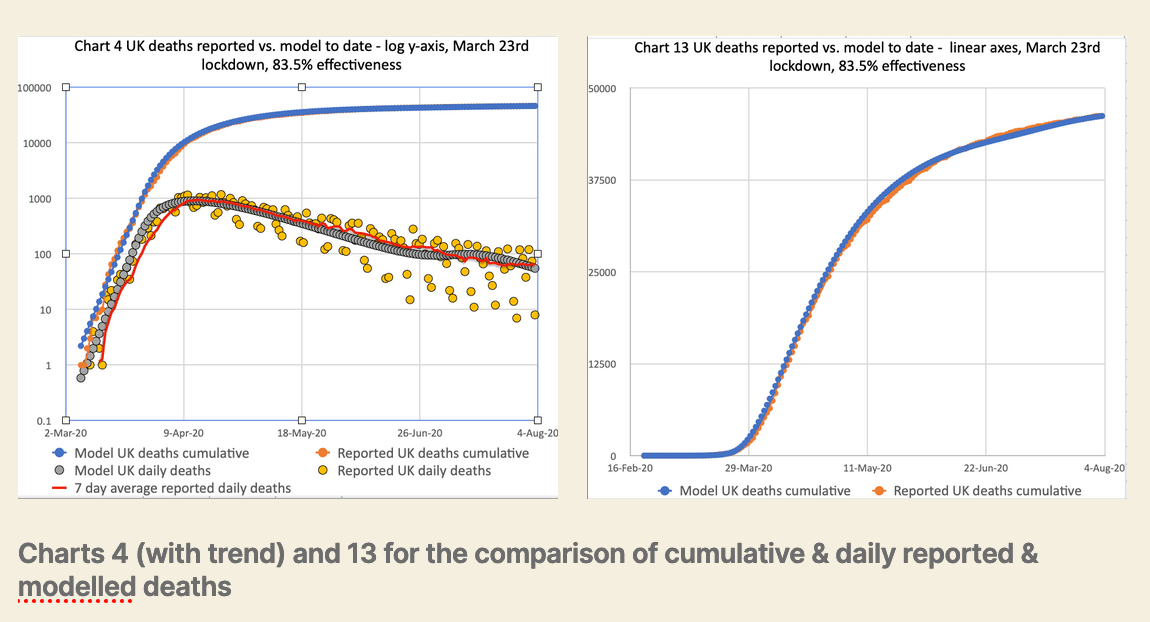
As I reported in my previous post on 31st July, the model I use, originally authored by Prof. Alex de Visscher at Concordia University on Montreal, and described here, was to be updated to handle several phases of lockdown easing, and I’m glad to say that is now done. Alex has been kind enough already to adopt a method I had been considering, of introducing an array of dates and intervention effectiveness parameters, and I have been able to add the recent UK Government relaxation dates, and the estimated effectiveness of each into a new model code. I have run two sets of easing parameters as a sensitivity test.
 A rambling mind