I reflect on my past experiences with event-based simulation, connecting it to Queuing Theory and the statistical mathematics used in telephone exchanges and modern technological applications, particularly gaming platforms like Zwift. I draw parallels between call arrival patterns and infection models, particularly regarding COVID-19. I acknowledge the influence of historical research, including work by Prof. Neil Ferguson, on understanding infection dynamics and the necessity for public health measures like social distancing. I emphasize the importance of mathematical modeling in managing infectious diseases effectively.
Tag Archives: Coronavirus
Reflecting on the UK’s First Coronavirus Lockdown: Five Years Later

This article presents two case number comparison charts for the 9th March and 23rd March 2020 UK Coronavirus lockdown dates. I had covered the deaths data in more detail in my previous post on this topic, and add that here too.
My Coronavirus model post-Pirola

I have updated my Coronavirus model to include an assessment of the potential impact of the new BA.2.86 Pirola variant. The model factors in age-group structures, transmission rates, vaccination phases, and non-pharmaceutical interventions. The model finds that despite reported decreases in Covid-19 cases in the UK, case recording has been high with recent data seeming erratic, with some inadequacy in the data reported by the Office for National Statistics (ONS) after it ceased its regular reporting. I source data from Worldometers, providing reliable Covid-19 figures. The accuracy of the model may be compromised by lower reliability of active case data.
My Coronavirus UK model outcomes as ONS reporting comes to an end

The UK Office of National Statistics (ONS) had just announced that it was ceasing publication of the regular cases and deaths outcomes of the UK Covid-19 pandemic, as of 24th March 2023, and then revised all previously published Covid data. I was able to make global changes to most of my model history, by re-working some of the early Variant characteristics in the model. This post reports the outcomes of that work.
Official UK Coronavirus reporting ends

Introduction I have continued to run my own Coronavirus model, my recent prior report on February 9th this year having immediately followed the outbreak of the “Kraken” variant, Omicron XBB.1.5, in the UK. This brief post provides my own latest charts from my model, in the light of cessation of the UK Government’s own CovidContinue reading “Official UK Coronavirus reporting ends”
The Kraken Wakes* – Coronavirus
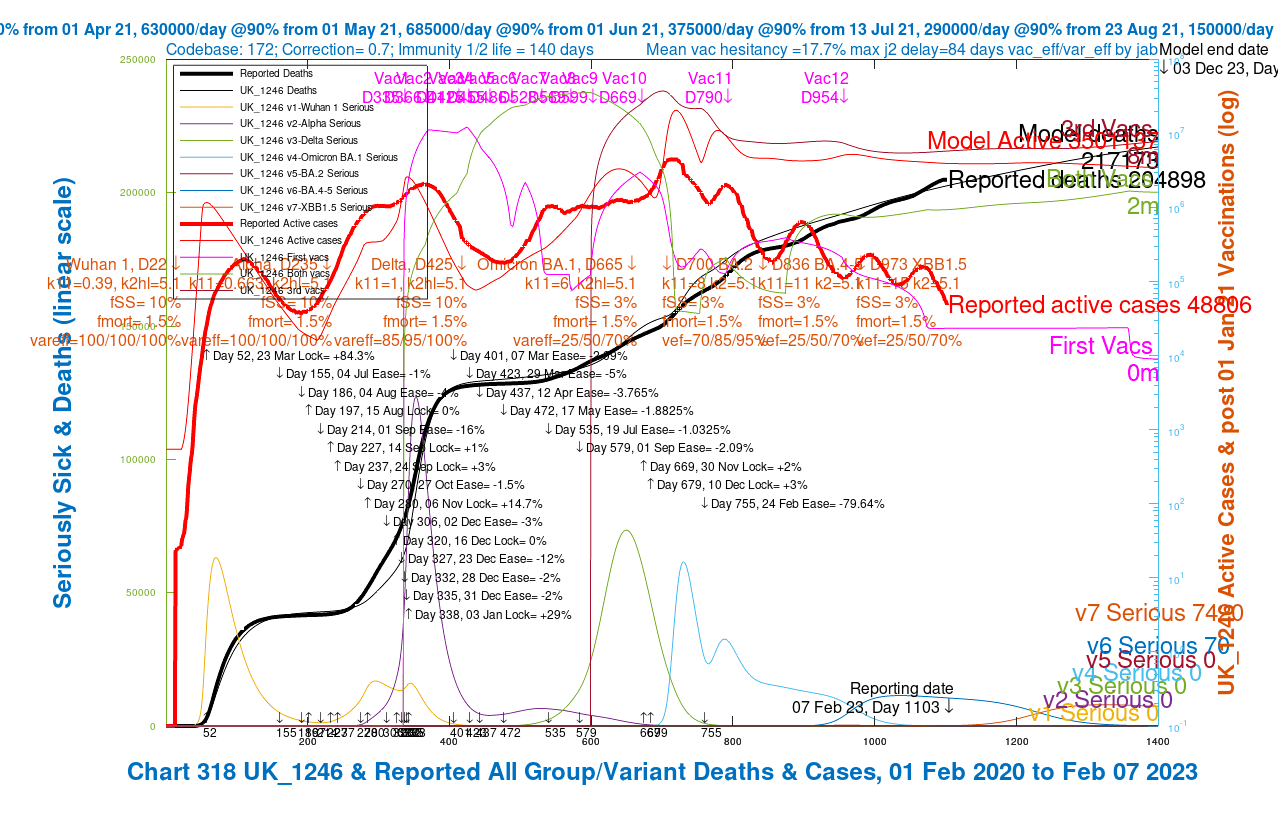
I have continued to improve and run my Coronavirus model daily. The code for the model is now at version 172, and I have added a dataset to represent the variant XBB.1.5, known informally as “Kraken”. The fit of the model to reported deaths is good. I explore in the article the behaviour of Modelled vs. Reported Active Cases.
Omicron continues to surprise – Coronavirus

Introduction In my most recent articles on the Omicron variants of Covid-19, I have highlighted the discrepancy between plummeting Active Cases and increasing cumulative Deaths. My model draws attention to this, by comparing the previous alignment of modelled and reported data, prior to February 24th, with the recent divergence. This post continues to summarise theContinue reading “Omicron continues to surprise – Coronavirus”
They think it’s all over – but it isn’t – Coronavirus

In this article, I present a few variations of the current model to illustrate some outcomes depending on different assumptions about the current dominant variant, Omicron BA.2; they are fairly consistent in their forecasts over the 1400 day period of the model, from the outset in February 2020 to December 2023, and show that as NPIs are removed, vaccination is what keeps us safe.
Omicron BA.2, vaccination for 5-11 year-olds, and the honeymoon period – Coronavirus

I haven’t needed to make significant updates to my Coronavirus model for a while, because it has been working well.
The original Omicron variant morphed into the new BA.2 variant, and although it seems no more dangerous than its predecessor, it is thought to be between 33%-50% more transmissible. I have assumed the lower value of 33% more transmissive for this post.
I have added Omicron BA.2 as fifth variant v5 to my model, with 8 times the transmissibility of Delta, compared with the original Omicron variant v4 in the model, at 6 times the Delta transmission rate.
A first 2022 Omicron update – Coronavirus

While it is still very early days, both in the New Year of 2022 and also for the Omicron variant, this post adds to my recent 19th December update with a summary of further runs of my model for higher transmissions settings. Last time I ran options up to three times the transmission rate of the Delta variant, and I have now looked at transmission up to five times the Delta rate.
 A rambling mind