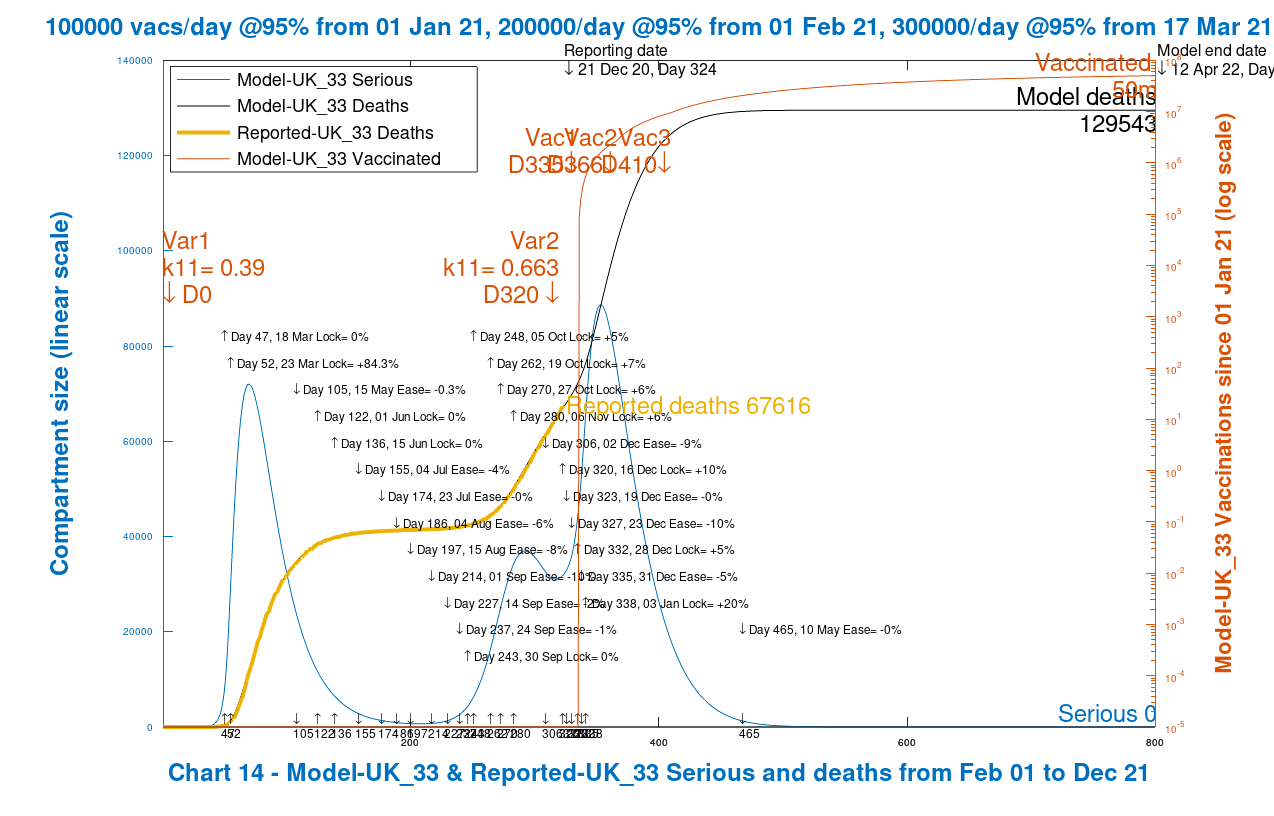
I cautiously welcomed “the end of the beginning”, and events since then have borne out the need for caution, with the discovery of a mutant variant of the SARS-Cov-2 virus (denoted VUI-202012/01) which seems to have a much greater transmission rate, as much as 70% more than the strain of SARS-Cov-2 we have seen previously in the UK. I have developed a further version of my Coronavirus model which now includes not only intervention capability but also a vaccination module, as reported before, and now the ability to add further virus strains with different transmission characteristics.
Category Archives: UK
USA Thanksgiving Coronavirus lessons for UK Christmas and New Year?
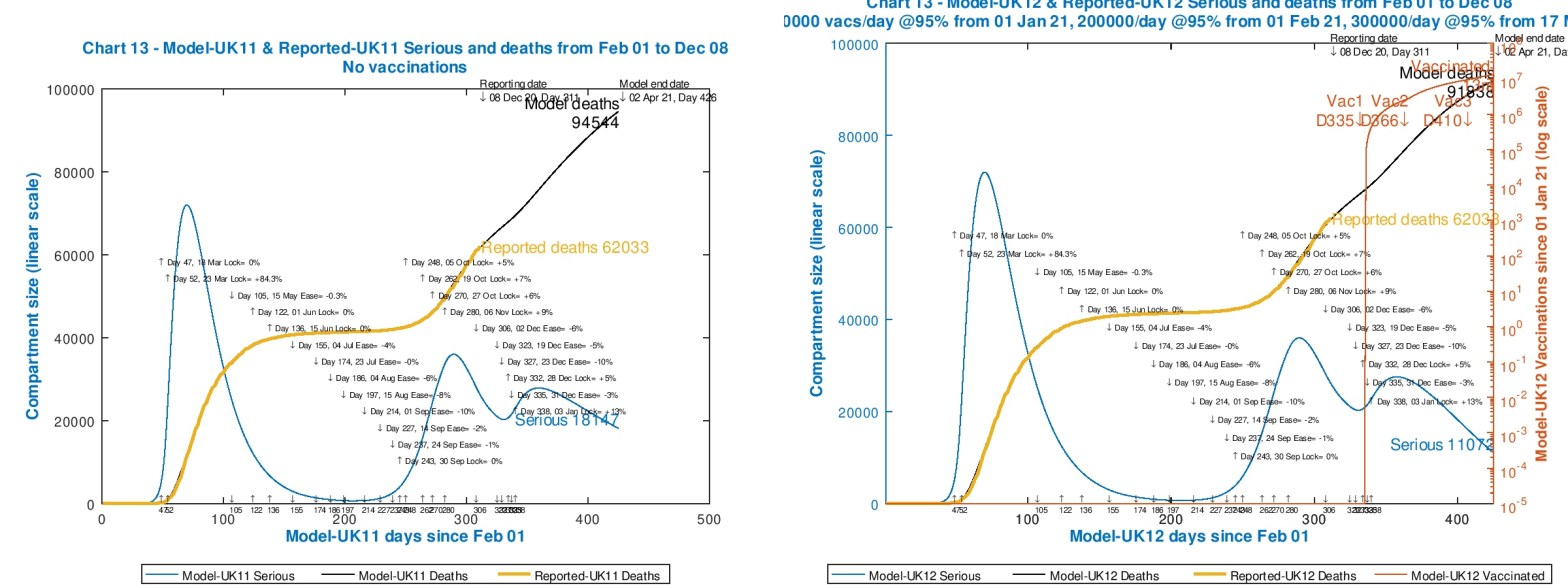
We are aware that the rates of cases and deaths in the USA have increased steeply recently, and it seems that the natural public relaxation in precautions against Covid-19 for the Thanksgiving holiday period have exacerbated this. I have run my model with reductions to the USA intervention effectiveness during the Thanksgiving period (reflecting the increase in travel and social interactions in the USA) followed by reintroduction of the intervention effectiveness afterwards, to see the effect on the immediate projections. I have then applied similar changes to my UK models, to anticipate what the possible effect of such relaxations over the UK festive period might be. This is very much a sensitivity test of some scenarios, not a forecast.
The end of the beginning* – Coronavirus
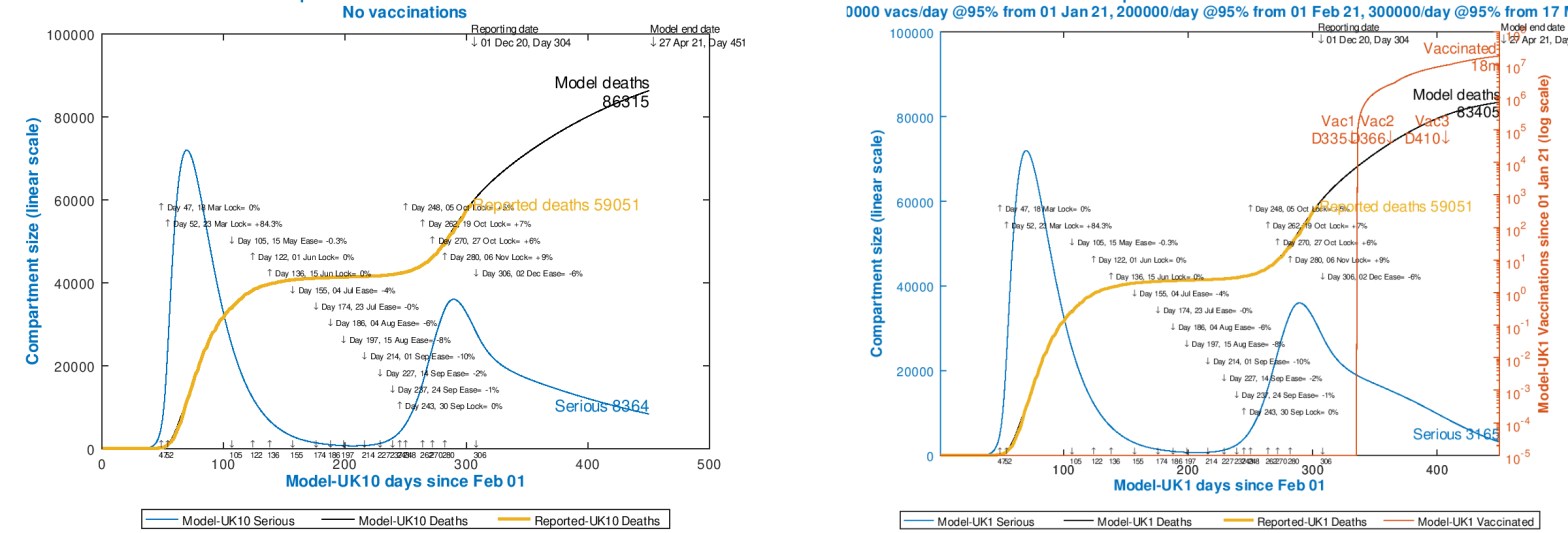
Now that it seems clear that a vaccination programme in the UK might start as early as next week, I have re-run my Covid-19 vaccination model for the UK, updating the November 25th scenarios (which begin on January 1st 2021) to reflect some potential UK outcomes.
Modelling of Coronavirus vaccine strategies
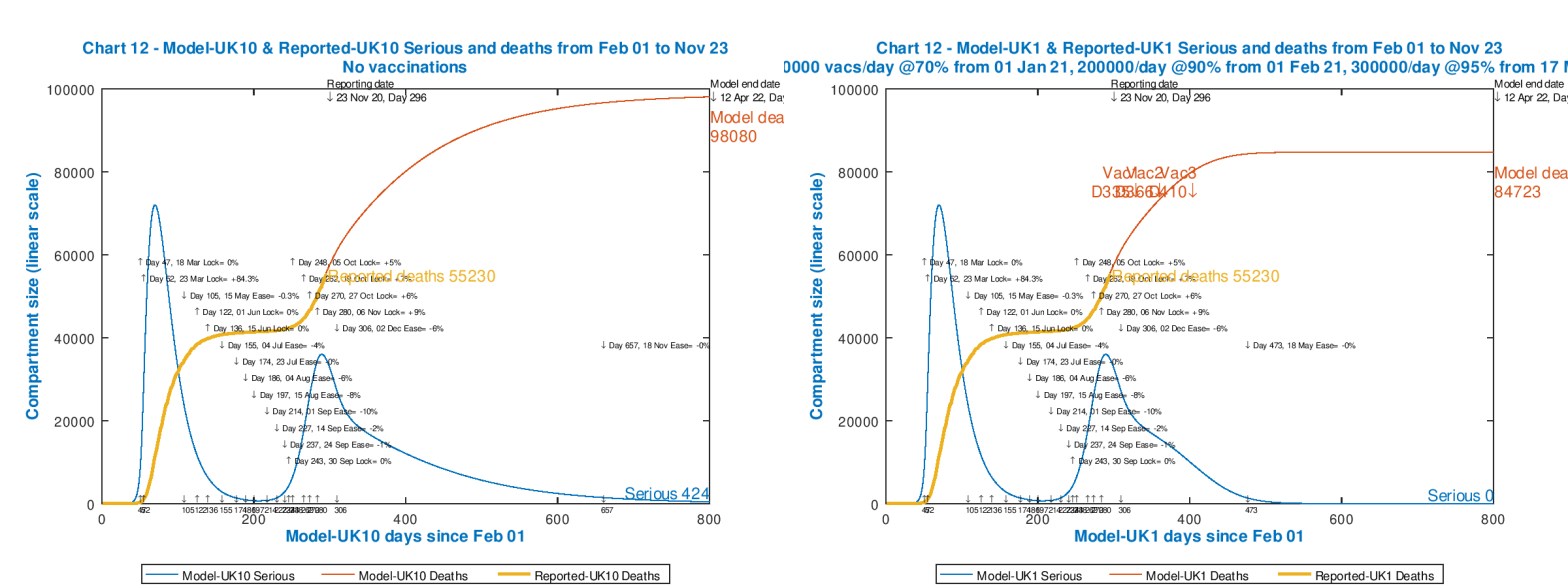
In my most recent post on November 18th, about updating my Coronavirus model to handle the impact of vaccines, I gave some examples of how case numbers, and more specifically death rates might be improved for the UK through a vaccination programme. Now that there seem to be several vaccines imminent, with efficacies ranging from 70% (Astra-Zeneca/Oxford) through 90% (A-Z/O via a different inoculation regime, and Pfizer), to 95% (Moderna) and several others in the mix, I explore some sensitivities in more detail, and also apply the model to the USA.
Vaccine, vaccine, vaccine, vaciiiine,…(don’t refuse it, just because you can) Coronavirus

In the news today, I read that Dolly Parton had given $1,000,000, through her Covid-19 Research Fund, to help fund the Moderna vaccine development. As The Times newspaper reported, this – erm – somewhat trumps the White House contribution to public safety. In her honour, Ryan Cordell composed and performed this ditty. The timing neatly coincides with the work I have been doing to incorporate vaccination into my Coronavirus model, and to that end I have been researching ways of modelling vaccination. I have made some appropriate changes, and run some model options for different vaccine efficacy; vaccinations per day; and date of starting the vaccination programme.
My model calculations for Coronavirus cases for an earlier UK lockdown

This post presents the two case number comparisons charts for the 9th March and 23rd March lockdown dates (I had covered the death data in more detail in my previous post on this topic).
Coronavirus modelling work reported by the BBC
This article by the BBC’s Rachel Schraer explores the modelling for the progression of the Coronavirus Covid-19. In the article we see some graphs showing epidemic growth rates, and in particular this one showing infection rate dependency on how many one individual infects in a given period. https://www.bbc.co.uk/news/health-52056111 This chart led me to look intoContinue reading “Coronavirus modelling work reported by the BBC”
 A rambling mind