
This article presents two case number comparison charts for the 9th March and 23rd March 2020 UK Coronavirus lockdown dates. I had covered the deaths data in more detail in my previous post on this topic, and add that here too.
Category Archives: LSHTM
My Coronavirus model post-Pirola

I have updated my Coronavirus model to include an assessment of the potential impact of the new BA.2.86 Pirola variant. The model factors in age-group structures, transmission rates, vaccination phases, and non-pharmaceutical interventions. The model finds that despite reported decreases in Covid-19 cases in the UK, case recording has been high with recent data seeming erratic, with some inadequacy in the data reported by the Office for National Statistics (ONS) after it ceased its regular reporting. I source data from Worldometers, providing reliable Covid-19 figures. The accuracy of the model may be compromised by lower reliability of active case data.
My Coronavirus UK model outcomes as ONS reporting comes to an end

The UK Office of National Statistics (ONS) had just announced that it was ceasing publication of the regular cases and deaths outcomes of the UK Covid-19 pandemic, as of 24th March 2023, and then revised all previously published Covid data. I was able to make global changes to most of my model history, by re-working some of the early Variant characteristics in the model. This post reports the outcomes of that work.
Omicron BA.2, vaccination for 5-11 year-olds, and the honeymoon period – Coronavirus

I haven’t needed to make significant updates to my Coronavirus model for a while, because it has been working well.
The original Omicron variant morphed into the new BA.2 variant, and although it seems no more dangerous than its predecessor, it is thought to be between 33%-50% more transmissible. I have assumed the lower value of 33% more transmissive for this post.
I have added Omicron BA.2 as fifth variant v5 to my model, with 8 times the transmissibility of Delta, compared with the original Omicron variant v4 in the model, at 6 times the Delta transmission rate.
A first 2022 Omicron update – Coronavirus

While it is still very early days, both in the New Year of 2022 and also for the Omicron variant, this post adds to my recent 19th December update with a summary of further runs of my model for higher transmissions settings. Last time I ran options up to three times the transmission rate of the Delta variant, and I have now looked at transmission up to five times the Delta rate.
Just as we thought it was safe to go back into the water – Coronavirus
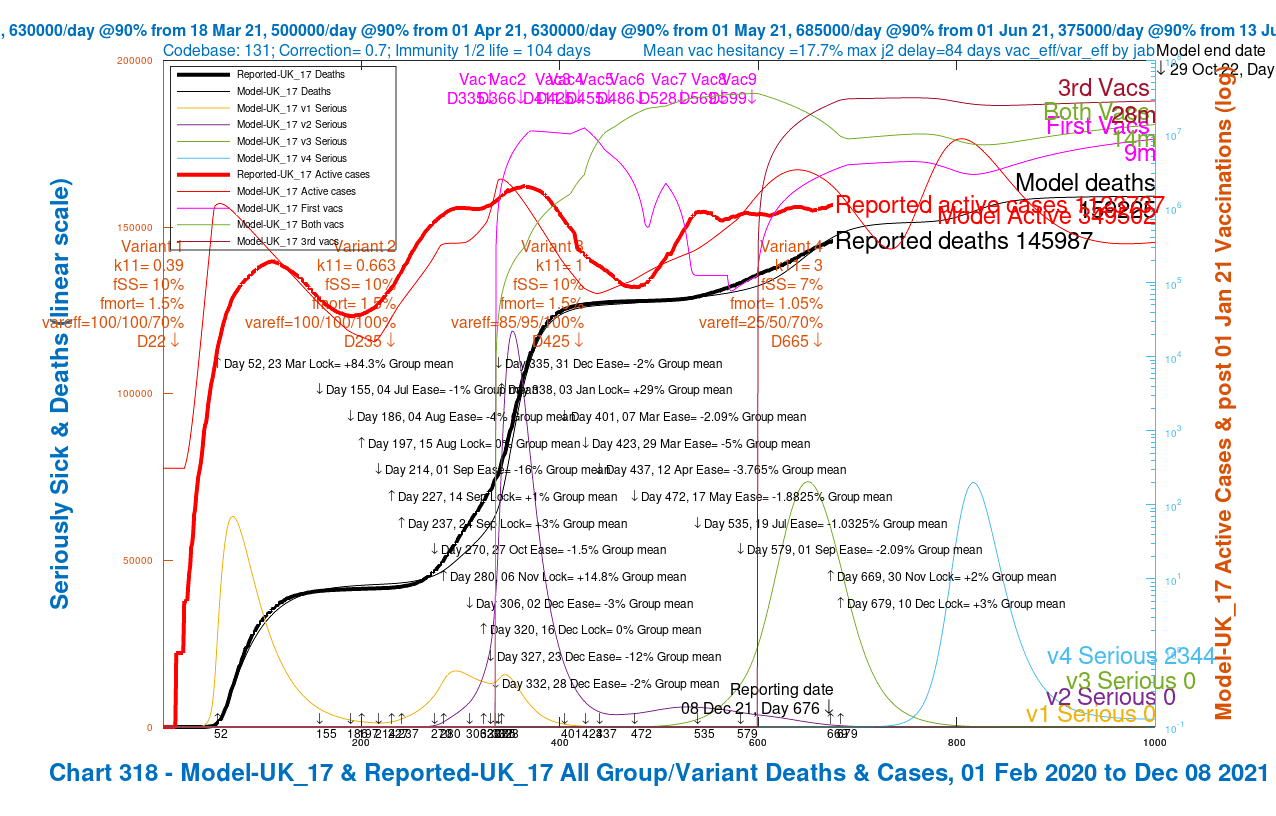
Omicron is feared to have higher infectiousness than the Delta variant, with even greater concerns should it turn out to cause more severe symptoms, higher mortality, and possibly worst of all, if it were able to evade current Covid-19 vaccines. I have made some parametric runs of my model to assess the possible effects.
My model calculations for Coronavirus cases for an earlier UK lockdown
This post presents the two case number comparisons charts for the 9th March and 23rd March lockdown dates (I had covered the death data in more detail in my previous post on this topic).
 A rambling mind