Introduction
I revived some brief notes recently that I had compiled some years ago to create my simple Introduction to Albert Einstein’s Theory of Special Relativity, promising later to address his far more difficult Theory of General Relativity (GR), that took even Einstein another 10 years to publish after his 2005 Special Relativity (SR), published in his “annus mirabilis”, as it became to be known, thanks to the ground-breaking work he did that year.
But for General Relativity, Einstein had to get help on Riemannian Geometry from a mathematician and an earlier classmate, Marcel Grossmann, who was instrumental in helping Einstein apply Riemannian geometry to the General Theory of Relativity. Grossmann introduced Einstein to differential geometry and tensor calculus, helping bridge the gap between Einstein’s physical intuition and the required mathematics of curved spaces between 1912 and 1914.
Einstein’s and Grossmann’s collaboration led to a ground-breaking paper, “Outline of a Generalised Theory of Relativity and of a Theory of Gravitation“(1), published in 1913, and one of the two fundamental papers that established Einstein’s theory of gravity. Einstein’s second paper presented “Covariance Properties of the Field Equations of the Theory of Gravitation Based on the Generalized Theory of Relativity”.(2)
Background
I hope that I can manage to remind myself of all I used to know about this topic from my years at King’s College, London (KCL), between 1964 and 1967, working for my BSc in Mathematics, and again between 1968 and 1972, for my PhD in Mathematical Physics, with a year in between at Trinity College, Cambridge for Part III of the Mathematical Tripos, when John Polkinghorne(3) was my supervisor.
I was lectured there by Paul Dirac and Fred Hoyle, with research seminars conducted by Stephen Hawking, four years ahead of me in his own research career, amongst many other Cambridge luminaries in Quantum Mechanics and Cosmology.
For my first degree at KCL, I took lectures from Profs Hermann Bondi and Felix Pirani, who also supervised me during my PhD years. I was lucky enough also to take lectures from (now Prof Sir) Roger Penrose, at that time at Birkbeck College in London, who collaborated with Stephen Hawking on many aspects of Cosmology and General Relativity, including Black Holes, for which Penrose shared the Nobel prize in 2020, which, in my opinion, should have happened many years before. Sadly, Stephen Hawking could not be included because he died in March 2018, and Nobel prizes cannot be awarded posthumously.
My introduction to General Relativity ought, then, to be well informed, but I have to say that after so many years, I will be re-learning it as I go, along with you, the reader! I have provided many references, mainly published books rather than research papers, so that relevant material is accessible and easy to find.
I’m going to keep Dirac’s little volume on General Relativity (4) and Hermann Bondi’s Assumption and Myth in Physical Theory (5) by my side as I write this article. Not only are they both short and accessible, but they also outline the development from Special Relativity to General Relativity, and introduce from there General Relativity’s need for curved spacetime and the supporting mathematics required, such as Riemannian Geometry.
I remember Dirac’s 1968 lectures on Quantum Mechanics at Cambridge very fondly, which ironically led me to choose to do research in Cosmology, rather than Quantum Mechanics, because he couldn’t satisfy me on the mathematical validity of the “renormalisation” needed in Quantum Mechanics to resolve the infinities arising in its relativistic field theory equations.
This struck me as mathematically unsound and hard to understand, which made it a poor basis for my commitment to years of research. Nowadays, that might well be somewhat resolved, but it doesn’t yet fully help the relationship with gravitation. We still don’t have “a theory of everything”, although both Quantum Mechanics and General Relativity work extremely well as separate theories.
One of my references is “Quantum Gravity”(17) by Carlo Rovelli, in which he explains Loop Quantum Gravity, a method he developed to bring the theories together. His 2017 book, Reality Is Not What It Seems(10), also explores these issues from a more recent perspective.
See the References section at the end for those books and other material.
Accelerated motion
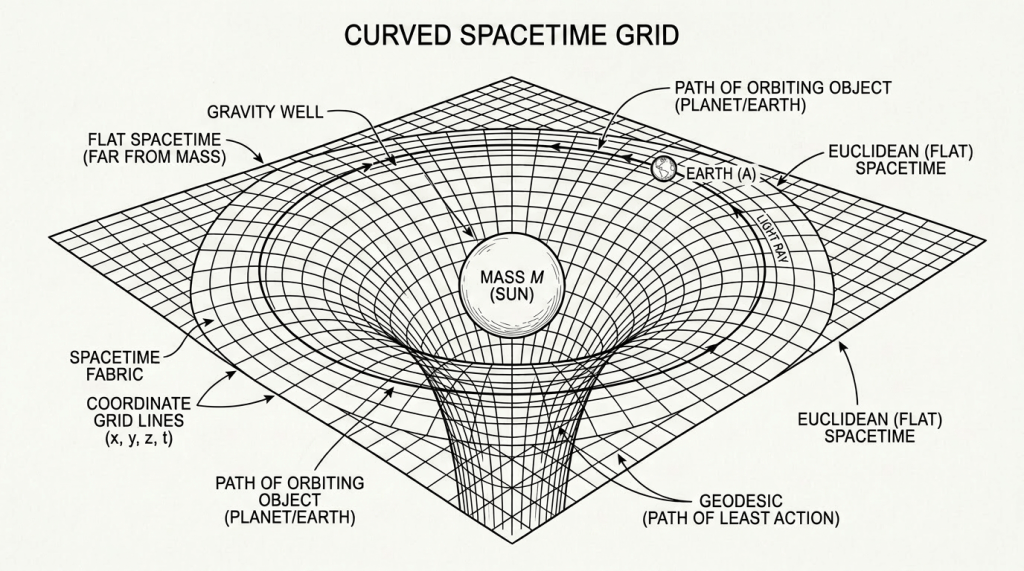
In my earlier article on Special Relativity, I analysed the motion of (inertial) observers in constant relative speed. It is possible to analyse the motion of accelerating (or decelerating) non-inertial observers by approximating the motion of a succession of inertial observers in “flat” spacetime. Forces induced by acceleration can also be managed. See Reference (3), p.53ff. But when acceleration is caused by the effects of gravity, a new theory based on different underlying geometry is needed.
Gravitation
While Newtonian mechanics can handle specific forces acting on an observer or particle, reflected in Newton’s laws of motion, gravity affects all bodies, including measuring instruments, varying with the relative speed and location of all gravitating masses, such as the Sun or the Earth, or, indeed, any massive bodies (bodies with mass).
Einstein’s later theory of General Relativity. deals with the relative acceleration of different particles under the force of gravity, including the relativistic effects of Special Relativity on these particles. In the small, General Relativity reduces to, and must be consistent with, Special Relativity, including the behaviour of light. In the large, when gravitational fields are weaker and spacetime is flat, it must reduce to and be consistent with Newton’s theory of gravity.
General Relativity more accurately describes the interactions of gravity and light, including its prediction of light bending around a massive body, such as our Sun.
Experimental confirmation of GR vs. SR
Einstein’s prediction of the extent of light bending around the Sun was confirmed by Sir Arthur Stanley Eddington and Frank Watson Dyson’s experiment in Príncipe, West Africa, during the solar eclipse on May 29th, 1919. Three astronomers — Arthur Eddington, Frank Watson Dyson, and Andrew Crommelin — played key roles in this 1919 experiment. Eddington and Crommelin travelled to locations at which the eclipse would be total — Eddington to the West African island of Príncipe, Crommelin to the Brazilian town of Sobral — while Dyson coordinated the attempt from England.
![img_6880-1
The 29th May 1919 solar eclipse, as recorded by Andrew Crommelin and his team at Sobral
ESO/Landessternwarte Heidelberg-Königstuhl/F. W. Dyson, A. S. Eddington, & C. Davidson - https://www.eso.org/public/images/potw1926a/
Almost exactly 100 years ago, a remarkable event occurred: a total solar eclipse. This eclipse was special in more ways than one. Firstly, at just under seven minutes in duration, it was the longest such eclipse in over 500 years. Secondly, it was used by astronomers to explore the then-new theory of general relativity — with successful and groundbreaking results. Einstein published his general theory of relativity in 1915. The total solar eclipse of 1919 offered the perfect opportunity to test it experimentally, by exploring whether — and how — the immense gravity of the Sun bends and distorts incoming light from more distant stars, as predicted by Einstein’s theory. For a brief moment during the eclipse, the Moon would block the Sun’s light in the sky and make visible some of the stars that lie close to the line of sight of the Sun, not normally visible during the daytime. By measuring the positions of these stars during the eclipse and comparing them to their positions at night, when the sun is not in the field of view, it would be possible to determine whether their light rays bends while passing close to the Sun. Three astronomers — Arthur Eddington, Frank Watson Dyson, and Andrew Crommelin — played key roles in this 1919 experiment. Eddington and Crommelin travelled to locations at which the eclipse would be total — Eddington to the West African island of Príncipe, Crommelin to the Brazilian town of Sobral — while Dyson coordinated the attempt from England. Eddington and Crommelin imaged the eclipse using the technology of the time: photographic plates made of glass. Sadly, the original plates from the 1919 expedition (one of which was reproduced in Dyson’s original paper) have been lost — but, luckily, copies of one of the plates were made and sent to observatories around the world to allow scientists everywhere to see the evidence in support of relativity with their own eyes. One copy of a plate from Sobral went to Landessternwarte Heidelberg-Königstuhl, who recently scanned theirs as part of the Heidelberg Digitized Astronomical Plates (HDAP) project [1]. The image shown here is arguably the highest resolution image of the 1919 eclipse, and is the result of applying modern image processing techniques — including image restoration, noise reduction, and removal of artifacts — to that plate copy (un-annotated version here). It unveils stunning details in the solar corona, a giant prominence emerging from the upper right part of the Sun, and stars in the constellation of Taurus (The Bull) that were used to confirm general relativity’s predictions [2]. Notes [1] HDAP receives funding under grant No. 00.071.2005 of the Klaus Tschira Foundation. The original high-resolution scan before the digital restoration is provided here for historical purposes. [2] Dyson’s original paper concludes with the paradigm-changing graph on p.332 plotting the displacements of the stars during the eclipse against their distance from the solar disc’s centre. This shows a clear relation (solid line) — the stars closer to the solar disc are deflected more than those further away, and by roughly the amount predicted by general relativity (twice that predicted by Newtonian theory, which is represented by the dotted line).](https://brianrsutton.com/wp-content/uploads/2026/05/img_6880-1.jpg?w=1024)
Eddington’s team at Principe and Crommelin’s at Sobral observed the bending of light from distant stars around the eclipsed Sun, consistent with Einstein’s theory, with greater bending than predicted by Newtonian theory. The outcomes are presented in the paper “Determination of the Deflection of Light by the Sun’s Gravitational Field, from Observations made at the Total Eclipse of May 29, 1919” by Sir F. W. Dyson, S. F. R., Astronomer Royal, Prof. A. S. Eddington, and Mr C. Davidson.
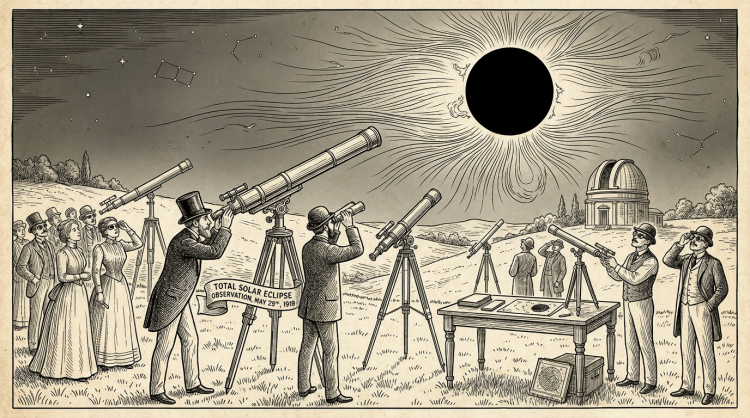
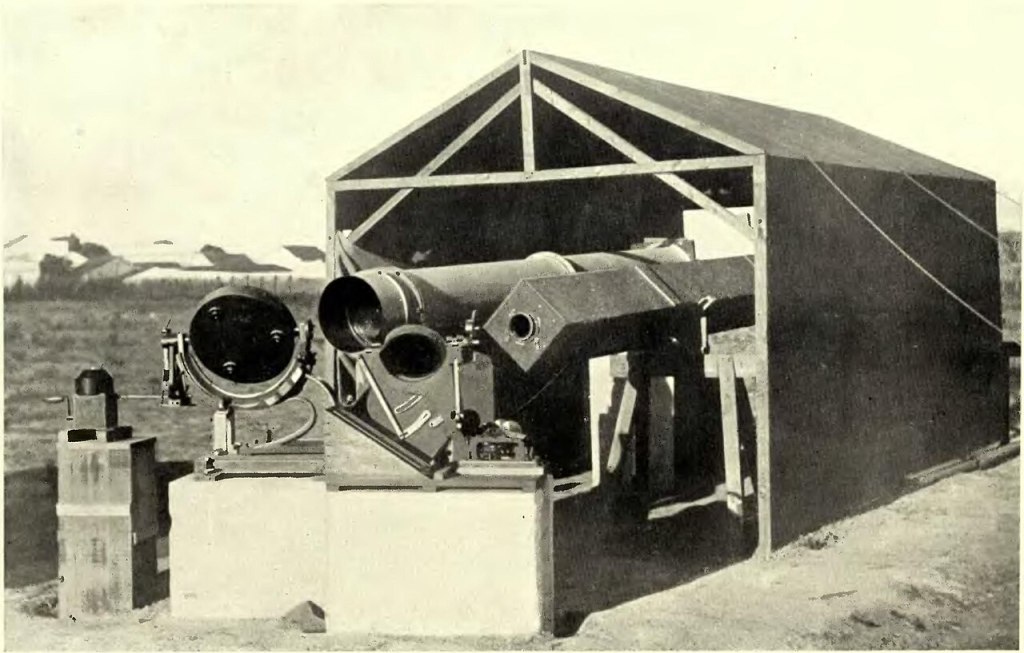
The telescopic equipment actually used in Sobral, shown below, used to measure light’s deflection around the sun, was far more substantial than that illustrated above.
https://royalsocietypublishing.org/doi/pdf/10.1098/rsta.1920.0009, Dyson’s, Eddington’s and Davidson’s original paper, concludes with a graph on p.332 plotting displacements of the stars during the solar eclipse against their distances from the solar disc’s centre, as shown summarised in the following diagram, which shows the radial displacement of the individual stars (mean from all the photographic plates) plotted against the reciprocal of the distance from the centre (in minutes, 1/60th of a degree). The closer the light passes to the Sun’s centre, the greater the displacement. The paper says that the Sobral results are more “trustworthy” than those from Principe, partly owing to some cloud cover at Principe and to better instrumentation at Sobral.
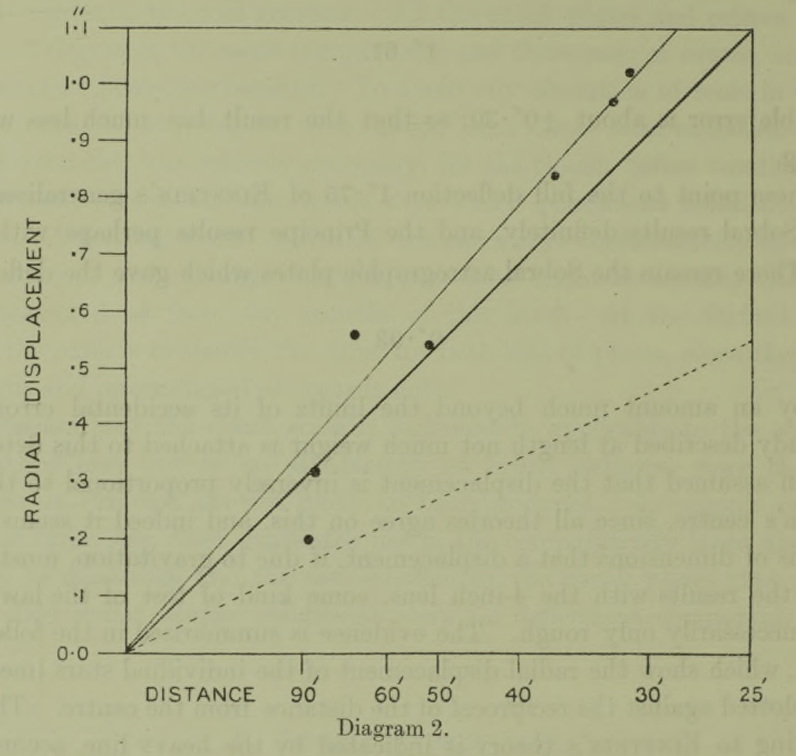
The predicted displacements according to Einstein’s theory are indicated by the heavy line; those according to the Newtonian law by the dotted line; and the best fit of the experimental observations by the thin line. This shows a clear relation: the stars closer to the solar disc are deflected more than those further away, and by roughly the amount predicted by General Relativity, about twice that predicted by Newtonian theory.
See https://en.wikipedia.org/wiki/Eddington_experiment for more.
References
These references are by no means a complete list of relevant support material for this article, but comprise relevant reading that I think offer a useful set of perspectives on this topic, from authors whom I respect, some historical and some more recent.
(1) Einstein, A.; Grossmann, M. (1913). “Entwurf einer verallgemeinerten Relativitätstheorie und einer Theorie der Gravitation” [Outline of a Generalized Theory of Relativity and a Theory of Gravitation]. Zeitschrift für Mathematik und Physik 62: 225–261, 245–261.
(2) Covariance Properties of the Field Equations of the Theory of Gravitation Based on the Generalized Theory of Relativity, Albert Einstein, May 1914, Z.Math.Phys. 63 (1914) 215-225.
(3) The Quantum World, John Polkinghorne*, Longman Group, 1984.
(4) General Theory of Relativity, Paul Dirac*; Princeton University Press, 1975.
(5) Assumption and Myth in Physical Theory by Hermann Bondi,* FRS, Cambridge University Press, 1967; The Tarner Lecture delivered at Cambridge in November 1965.
(6) Relativity, the Special and the General Theory, Albert Einstein (originally 1916), Wings Books, 1961.
(7) Stars and Atoms, A.S. Eddington, The Scientific Book Club edition, 1942, from Eddington’s discourse at the British Association in Oxford, 1926.
(8) Brief Answers to the Big Questions, Stephen Hawking*, John Murray Publishing, 2018.
(9) Facts and Speculation in Cosmology, Narlikar and Burbidge*, Cambridge University Press, 2008.
(10) Reality is Not What it Seems, Carlo Rovelli, 2017.
(11) Fashion, Faith and Fantasy in the New Physics of the Universe, Roger Penrose*, Princeton University Press, 2016.
(12) Dance of the Photons, Anton Zeilinger; Farrar, Straus & Giroux, 2010.
(13) The Role of Gravitation in Physics, Chapel Hill Conference 1957, Max Planck Research Library for the History and Development of Knowledge Sources 5, 2011.
(14) Astronomy and Cosmology, Fred Hoyle*, Freeman & Co., 1975.
(15) Einstein: A Hundred Years of Relativity, Andrew Robinson, Princeton University Press, 2015.
(16) General Relativity: the Essentials, Carlo Rovelli, Cambridge University Press, 2021.
(17) Quantum Gravity, Carlo Rovelli, Cambridge Monographs on Mathematical Physics, 2004.
*The asterisked referees are, or were, personally known to me.

