Introduction
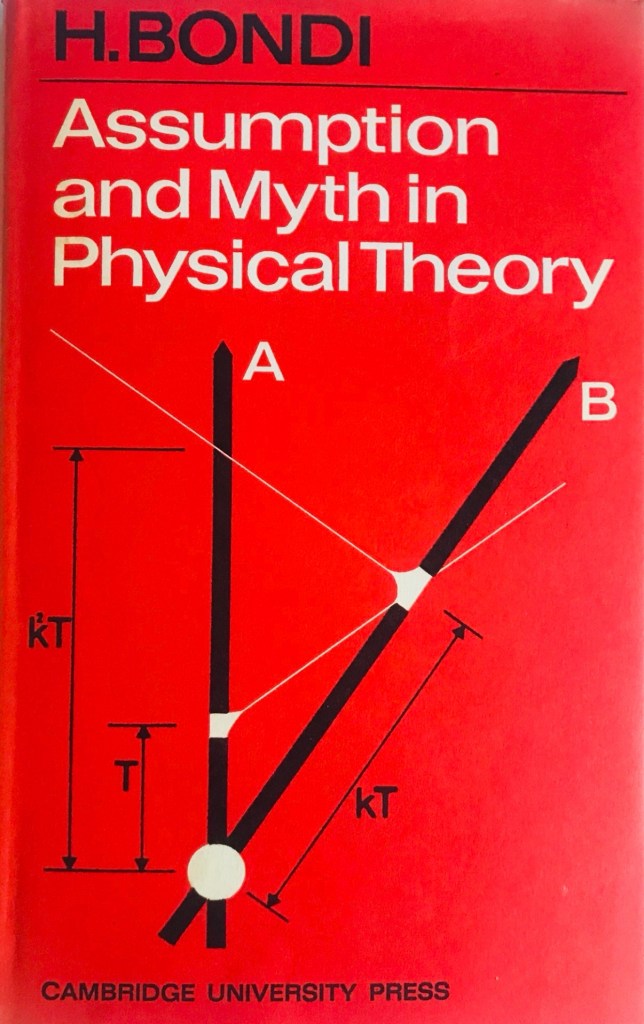
This article provides a simple introduction to Einstein’s Special Relativity, using Prof Hermann Bondi’s k-calculus, which he introduced to us at King’s College, London Mathematics department in the late 1960s. I have added a reference to Bondi’s excellent little book “Assumption and Myth in Physical Theory”, which includes some discussion of his k-calculus, and whose dust cover contains this characteristic k-calculus illustration.
Special Relativity explains why time can pass at different rates for observers moving at different speeds relative to each other, and why the length of the same object can be measured differently by those observers. The difference in those observers’ speeds must be a substantial fraction of the speed of light for the effects to be noticeable, but they are always there.
Special Relativity vs. General Relativity
Following Einstein, I will cover General Relativity in a later article; it is a far more difficult theory, as evidenced by the fact that it took Einstein 10 years from 1905, when he introduced Special Relativity, until 1915/16, when General Relativity was introduced. General Relativity requires curved spacetime, using Riemann’s mathematics of curved spaces, rather than “flat” spacetime, the standard Cartesian geometry we all used at school, where Special Relativity finds its setting. Special Relativity caters only for “inertial observers”, who move at constant relative speed to each other, with no acceleration.
Einstein had relied on colleagues to explain Riemannian geometry to him when he realised he needed something more than Cartesian geometry to make progress with General Relativity. Marcel Grossmann, a mathematician and Einstein’s classmate, was instrumental in helping Albert Einstein apply Riemannian geometry to the General Theory of Relativity. Grossmann introduced Einstein to differential geometry and tensor calculus, helping bridge the gap between Einstein’s physical intuition and the required mathematics between 1912 and 1914. Einstein’s and Grossmann’s collaboration led to a ground-breaking paper, “Outline of a Generalised Theory of Relativity and of a Theory of Gravitation“, published in 1913, and one of the two fundamental papers which established Einstein’s theory of gravity.
There is no gravity in Special Relativity. John Archibald Wheeler, a renowned theoretical physicist, famously (and possibly apocryphally) summarised Einstein’s General Theory of Relativity in the single, elegant sentence: “Spacetime tells matter how to move; matter tells spacetime how to curve.” But in Special Relativity, there is no gravity, and so, in effect, there is no matter (mass) affecting the geometry of spacetime.
How do we observe things?
In the following discourse, we shall describe the use of light rays to communicate and observe what is happening. Rather than “smoke and mirrors”, our observers will use torches and mirrors.
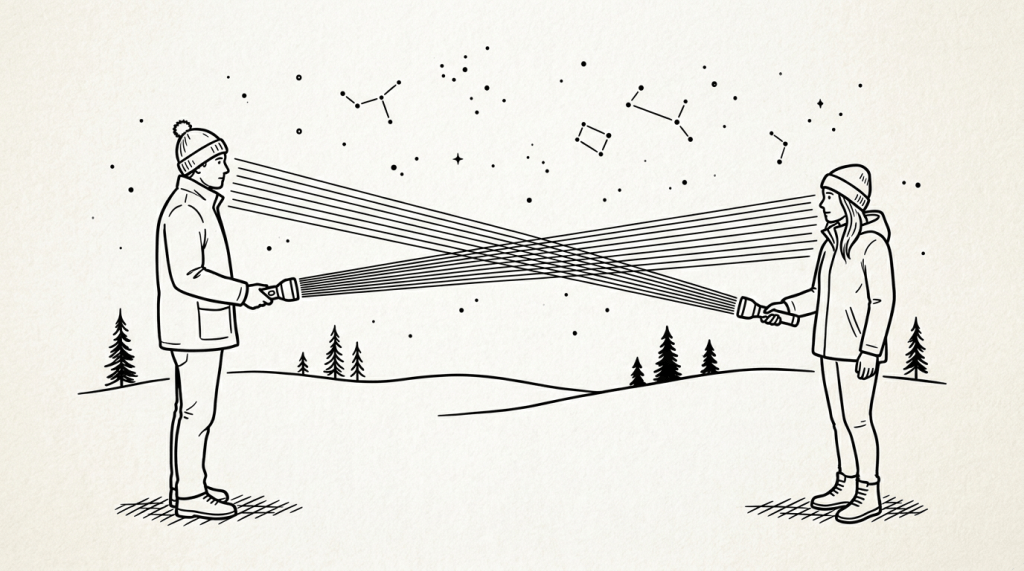
The torches will allow observers to send signals, and mirrors can also help recipient observers to send a signal back as soon as it is received.
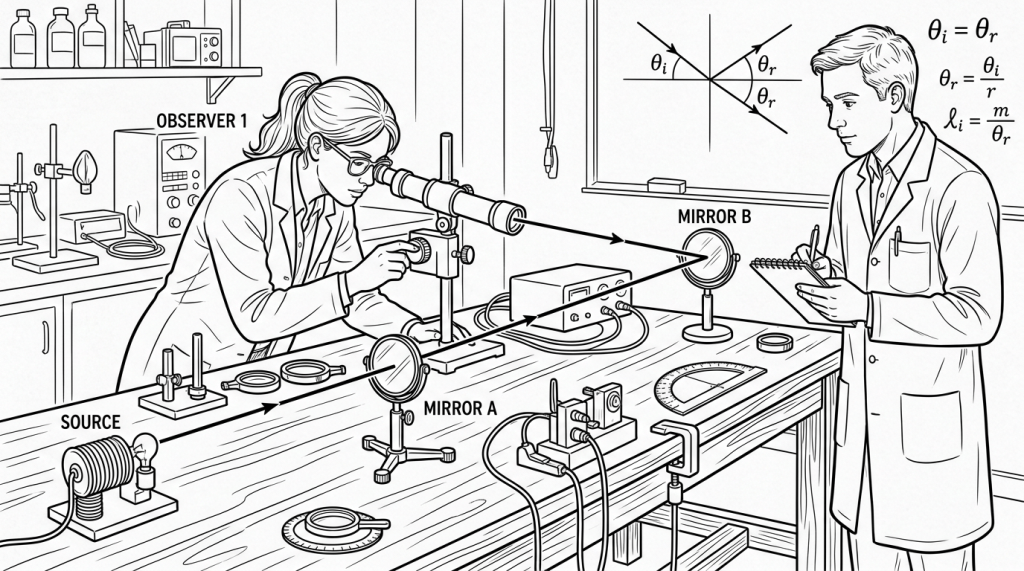
These light rays all travel at the invariant speed of light, which decades of experiments have confirmed is always observed to travel at the same speed, no matter the position or movement of its source or an observer. It’s actually quite a counterintuitive concept, and is absolutely at the heart of the theory of relativity.
It is counterintuitive because we are all familiar with the concept and observation of the relative motion of physical objects in our daily lives. This counterintuitive nature is why Special Relativity’s time dilation and length contraction are called “paradoxes” by some. I will talk about those later on.
Relative motion
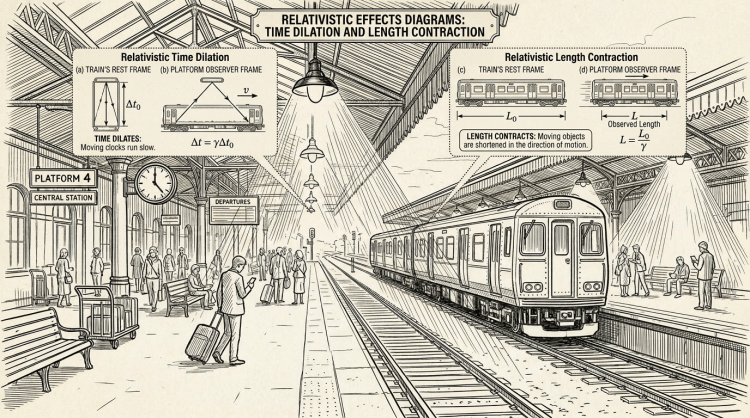
If I walk at 5kph (kilometres per hour) along a train carriage in the direction a 60kph train is travelling, then someone standing at the side of the track will measure my speed relative to them at 65kph; if I were to turn around and walk the other way, opposite to the train’s direction of motion, that person would see me moving past them at 55kph.
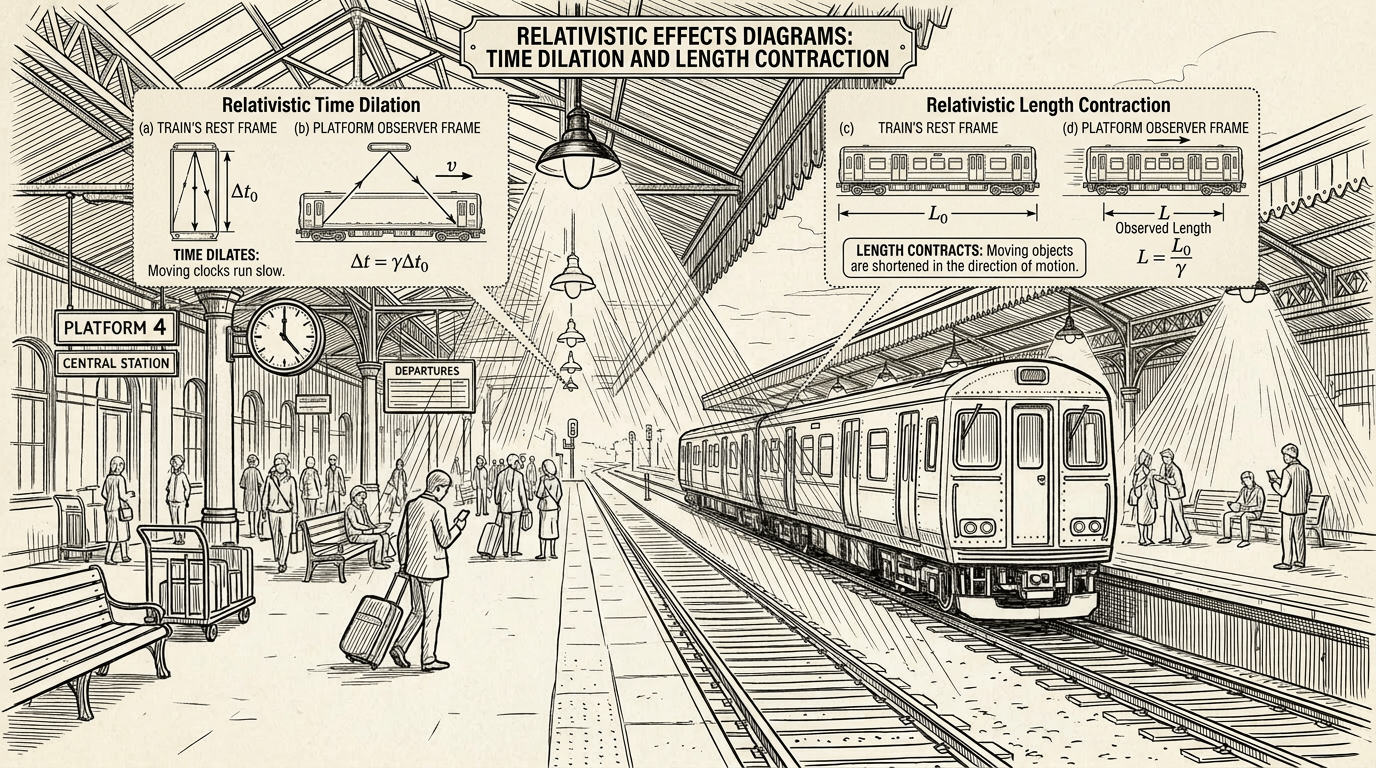
If that person is travelling in a car at 55kph in the same direction as the train, that person (or, rather, their passenger!) sees me stationary relative to them as I walk back along the train. That is relative motion as we normally experience it. But the drawing here highlights how Relativity changes the perceptions of time and distance by different observers. But these changes, as I mentioned, are only perceptible when relative speeds are very high, a significant fraction of the speed of light.
Einstein’s pivotal assumption, corroborated by innumerable experiments ever since the famous Michelson-Morley experiment of 1887, was that we always see light passing us at the same speed, irrespective of our own speed, whether towards or away from the light source. In that sense, this apparently simple assumption is not only counterintuitive but, as we will see, is fundamental to all that follows, and, indeed, to all of physics and science.
One such version of the Michelson-Morley experiment uses an interferometer to look for shifts in interference fringes between the two beams, aiming to measure the effect of the Earth’s speed through the hypothetical aether. See https://testbook.com/physics/michelson-morley-experiment.
The experimental setup comprises a light source S, a beam splitter P, mirrors at M1 and M2, and a detector T to detect the “aether wind” by splitting a light beam into two perpendicular paths towards mirror M1, perpendicular to the direction of travel of the apparatus, and mirror M2, parallel to the direction of v, the direction of travel of the apparatus owing to the Earth’s (and laboratory’s) motion. The two beams are recombined in the apparatus, towards the detector T, to analyse any changes in the interference fringes due to differences in the speed of light in those directions through the “aether”.
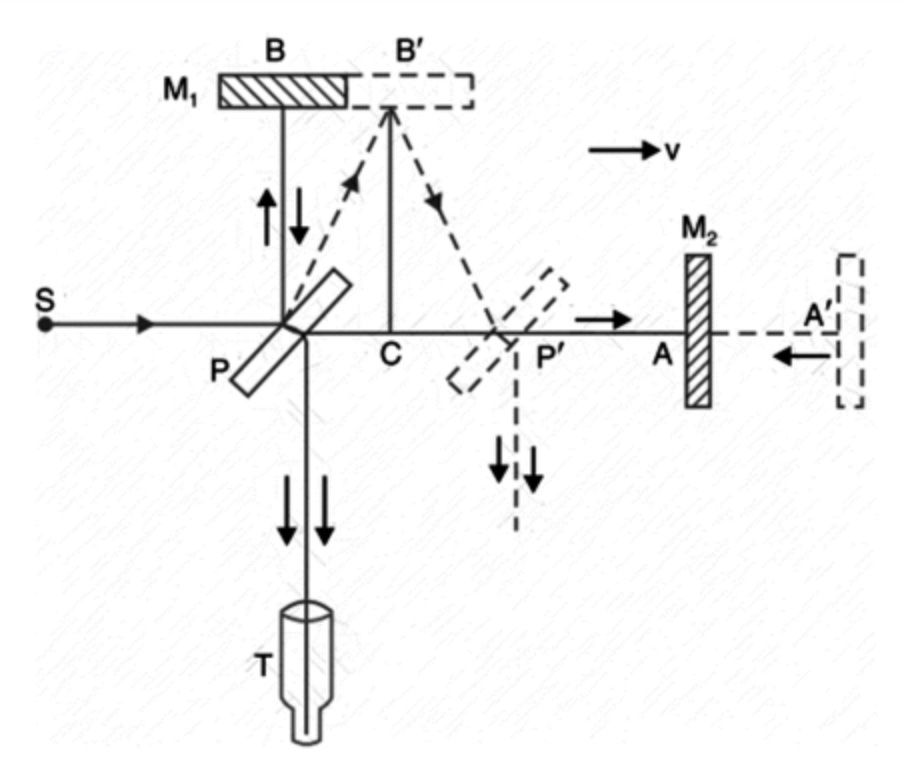
Ironically, that 1887 Michelson-Morley experiment was a failed experiment, in that the scientists had expected to measure a shift in light interference patterns as the Earth moved through space, because their prevailing assumption had been that light travelled though a medium called the “aether”, and they thought that the Michelson-Morley experiment, measuring the speed of light in a laboratory, would demonstrate that our own Earth’s motion through the aether would show interference patterns as the light moved in one direction or the other, relative to the aether, when comparing light rays along the Earth’s direction of motion, v in the diagram above, or perpendicular to it.
Instead, they found no significant difference, demonstrating that the speed of light is constant, regardless of the Earth’s motion. This “null result” disproved the aether theory (as did many other subsequent experiments) and paved the way for Einstein’s theory of special relativity.
[I mention here, in passing, that two researchers, J. A. S. Lima and Fernando D. Sasse, published an article in 2017, “Can Lorentz transformations be determined by the null Michelson-Morley result?” asserting that the assumption of the invariance of the speed of light might not be necessary as an assumption, as it can be directly deduced from an optical experiment, as above, in combination with the principle of relativity. See Reference 2.]
Light cones
For most of the time in this article, I will present diagrams in the (t,x) plane, as most key points can be made clearly that way. But you will often read about or hear the term “light-cone”, which is a 3D object, so I will explain what it means.
Light travels at just under 300,000 kms/sec (kps), but in agreement with tradition, we will call this speed “c” and choose units to renormalise it to c=1. Thus, someone travelling at 30,000 kps would be travelling at 0.1 in these renormalised units.
With this choice of c=1, if we were to plot light’s “motion” on a simple x–t chart (labelling the vertical axis as “t” for our purposes), then light travels on lines at 45° to these x and t axes.
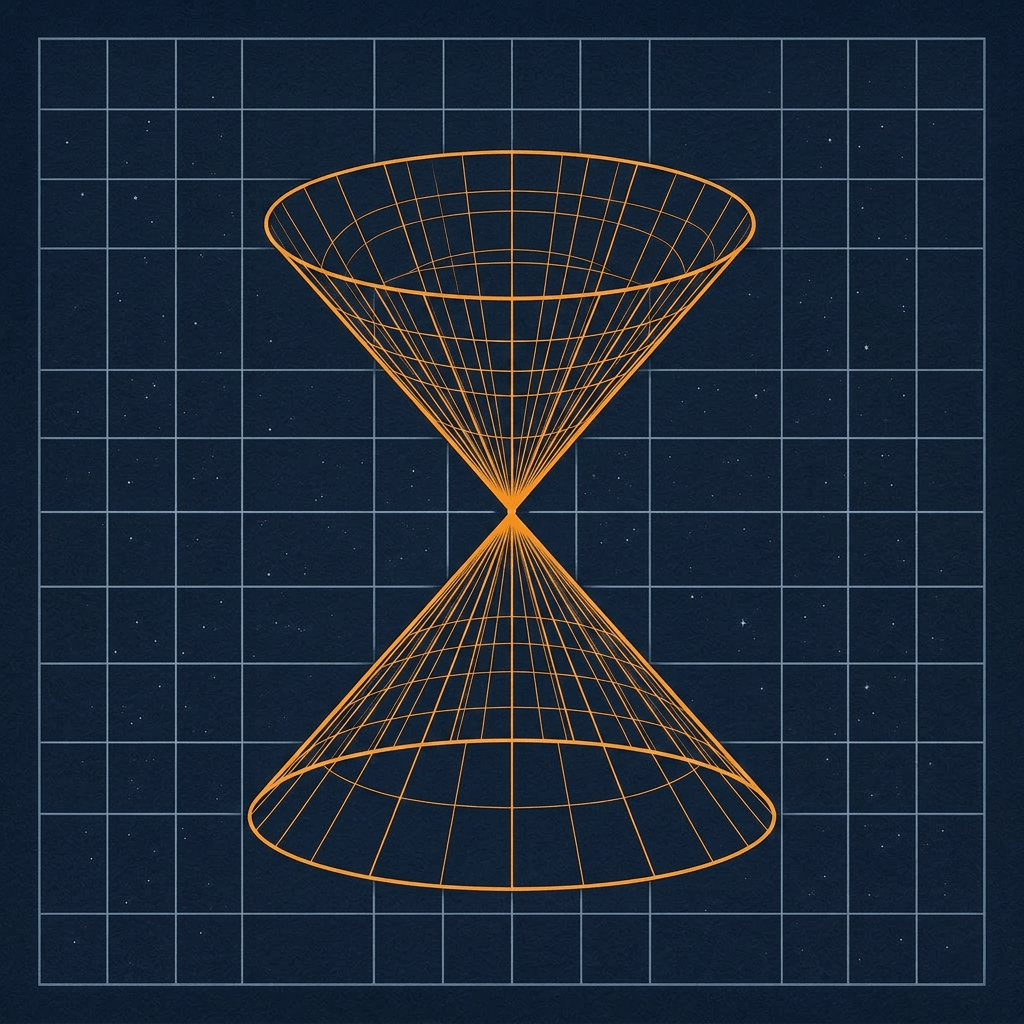
Similarly, if we were to plot a ray of light using a 2-dimensional (x,y) plane for our spatial measurements, and a vertical t-axis for time (perpendicular (or normal) to that (x,y) plane) and then consider light’s movement in that (t, x, y) space, then all possible light rays, emanating from the origin O of the three axes of this space, would form the surface of a cone, with its point at the origin, with semi-cones upwards and downwards from there, with all light rays originating at O traced on the surface of the cone, all at 45° to the (x,y) spatial plane.

Forgive the gaudy colours in the first image – I used WordPress’s new Jetpack image creation tool to render this light cone, [actually set in curved space grid lines, but that is another story for General Relativity]. I probably don’t like it any more than you do! But it does convey the double cone pictorially that I was trying to describe in words. Ignore everything else in the image!

Here is a more sober version with Cartesian grid lines of a light cone image.
Here is a one-dimensional version from my original notes of years ago, from my original handwritten text and diagrams I am reproducing for this article.
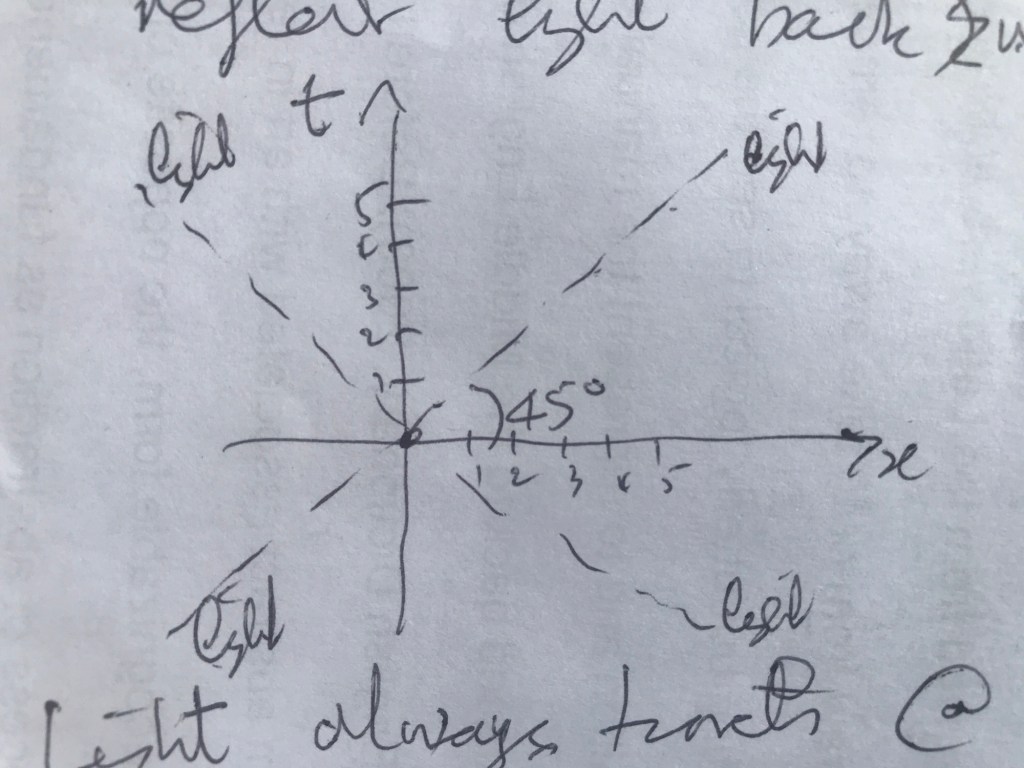
In the diagrams above, light always travels at 45° to the gridlines, at 1 x-unit per unit time t interval, a speed of c=1.
The meaning of “simultaneous” events
I will take some time to explain simultaneity of events, including how we measure time and distance using light beams in Special Relativity, as it is fundamental to understanding how simultaneity differs for observers in relative motion to each other, a crucial outcome of Special Relativity.
We will find that different observers can see different events as “simultaneous” and can disagree about whether the same two events are simultaneous, depending on their relative motion.
But first, let us define simultaneity. In what follows, I will talk about two observers – Abel (usually me!) with coordinates (t,x), and, later on, Bar, whose time t̅ and spatial x¯ coordinates will be barred, as in (t̅,x¯).
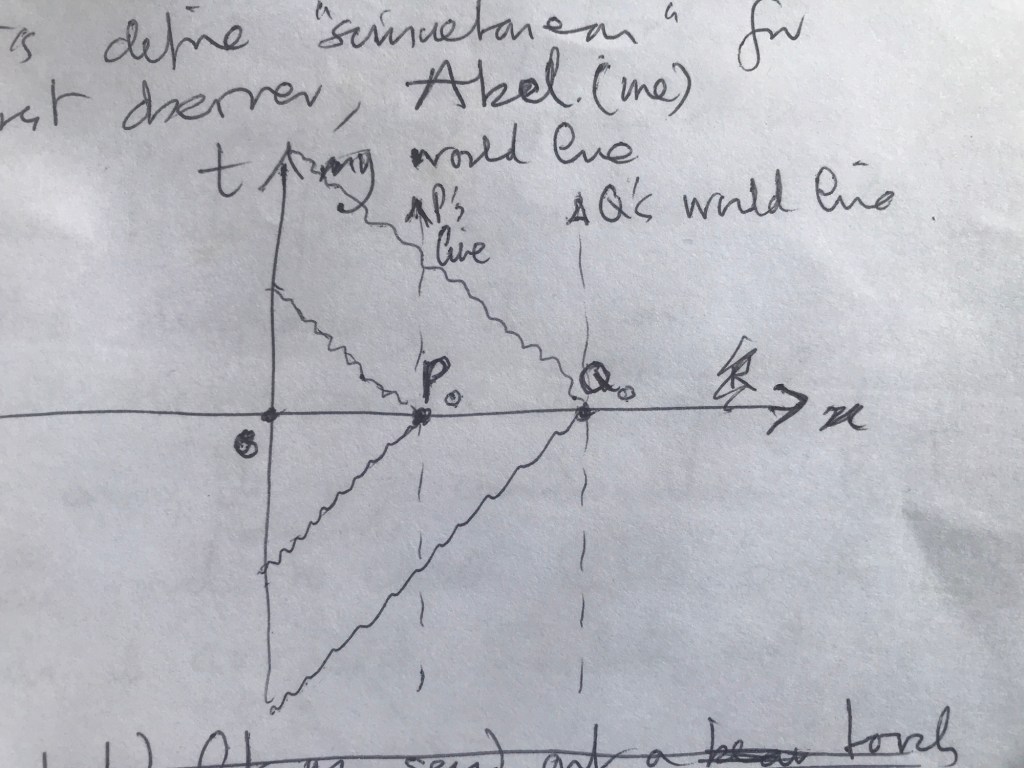
What is the vertical t-axis here? It is my (Abel’s) “world line”. If I don’t move, in my own (t,x) coordinates, my life progresses up the t-axis with no “spacelike” x-axis movement. The points P (a TV screen, perhaps) and Q (a wall mirror across the room, say) have world lines too, shown as dashed vertical lines in the diagram.
P0 and Q0 are snapshots of P‘s and Q‘s states at my time t=0 (P0 may be a 9am breakfast TV programme snapshot). Many seconds (4 hours) later, at t=14,400 seconds, P14400 might be showing the 1 o’clock news.
P0 and Q0 are called events, in the language of relativity, and they are simultaneous for me, at t=0. Why is this so?
I can use my torch (all observers have a torch and a mirror in this experimental world) to illuminate firstly Q0 (which is further away so I shine my torch earlier) and then a little later towards P0 (maybe the TV screen!), and then receive my light beams back (later on my world-line) from mirrors at Q0 and P0, (or by light beams sent by the observers with whom I have arranged for them to signal back at those points P0 and Q0 as soon as they receive my light signal), as shown in the diagram above by the squiggly lines.
I can calculate the coordinates of both P0 and Q0. I need to know 3 things for both: their distance away, how long it takes from my emission of the light beam to my reception of the return beam, and the speed of light, using the simple formula d = ct, as I’ll show in a moment.
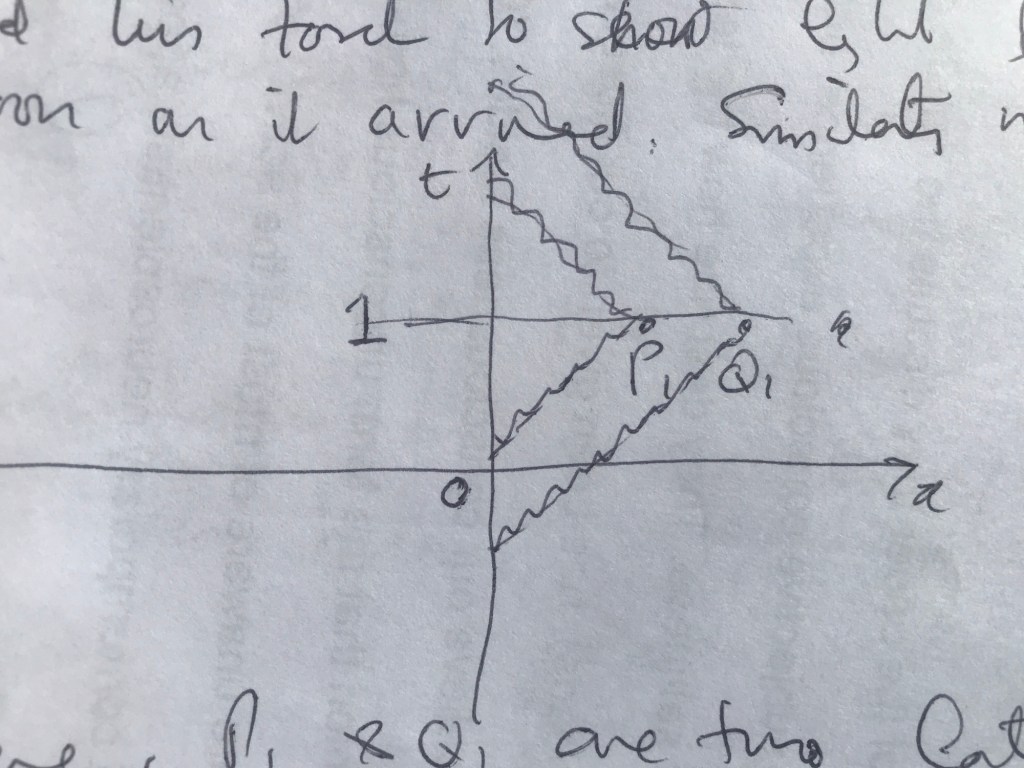
In this diagram, P1 and Q1 are two later events, maybe the TV and the mirror, 1 second later, and we can see that they are also simultaneous for me. These could have been at the time of the 1 o’clock news at t=14,400 rather than t=1.
Non-simultaneous events
In the following diagram, P2 and Q0 are NOT simultaneous for me.
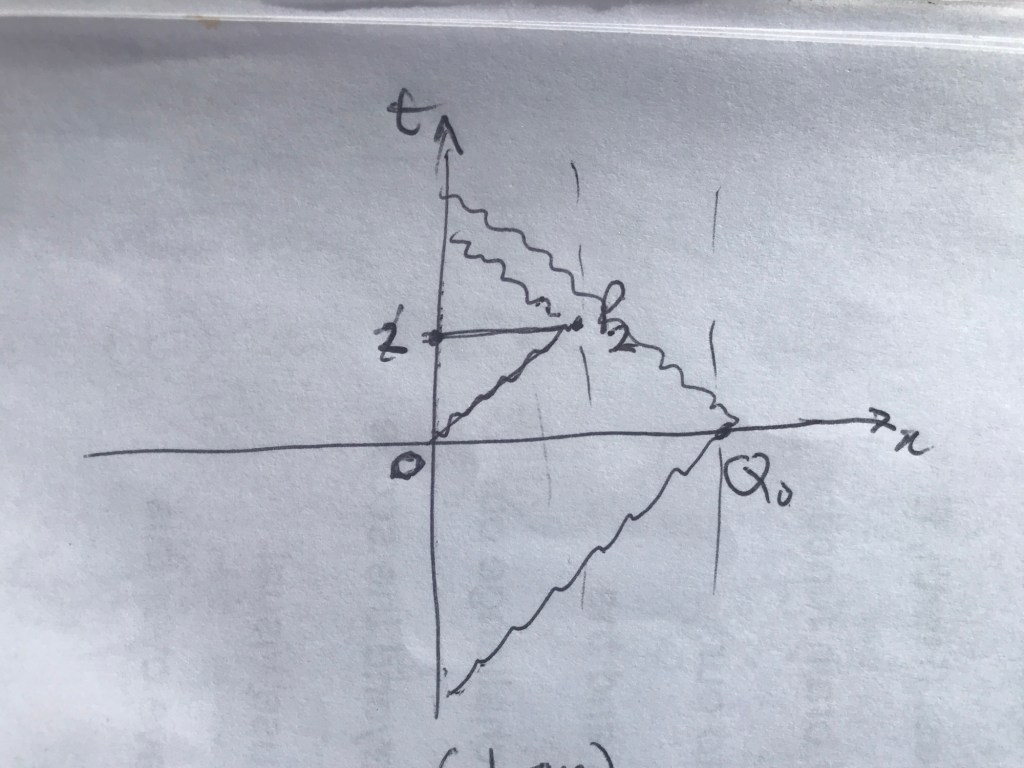
The method of calculation of the time for the round trip of the light beam (and therefore the distance away of P2 and Q0, at the time they are illuminated), and the calculation of the time of reception of the light beams, is shown below.
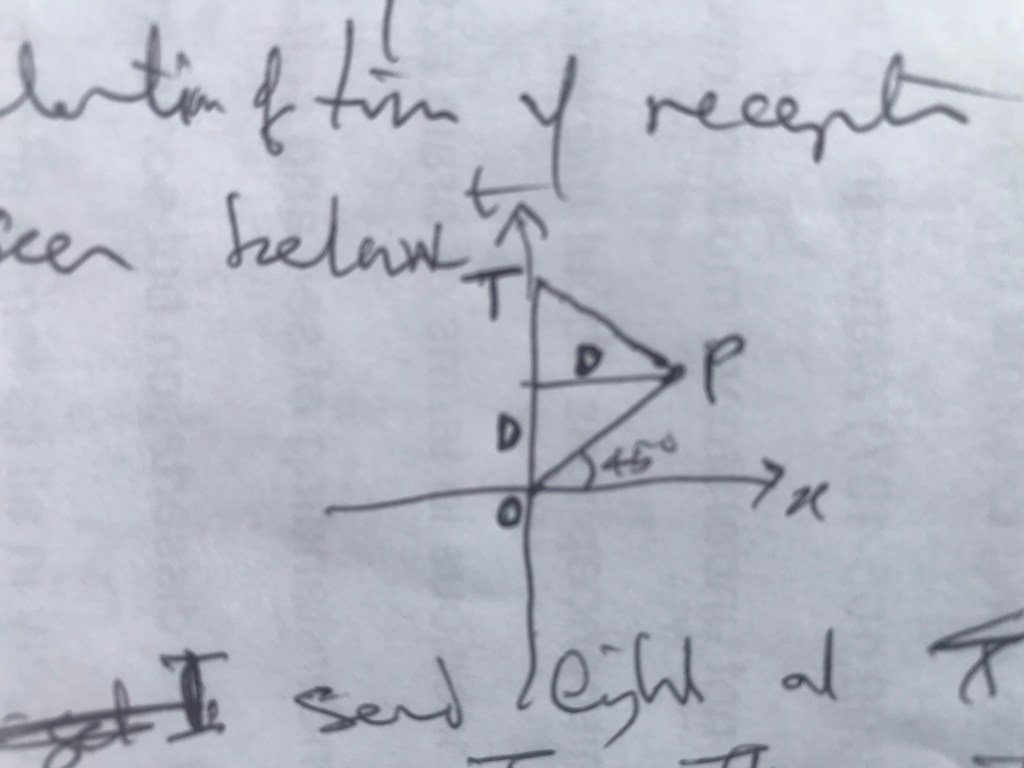
Suppose, as in the diagram, that I sent light out at time t=0 towards P, and received it back at time t=T. Thus, the time for the round trip is T, measured by my clock, and so I calculate that the time for the one-way trip out (or back) is T/2. It is reasonable to assume that the outward and return times (T/2) for the light beams are the same.
Since light has speed c=1 in the units we are using, and that distance (d), speed (v) and time (t) are related by v=d/t, or d=vt, my distance D away from the point P is given by
D = 1xT/2 = T/2,
The point P1 in the diagram below is T/2 units up the t-axis, with coordinates (T/2, T/2).
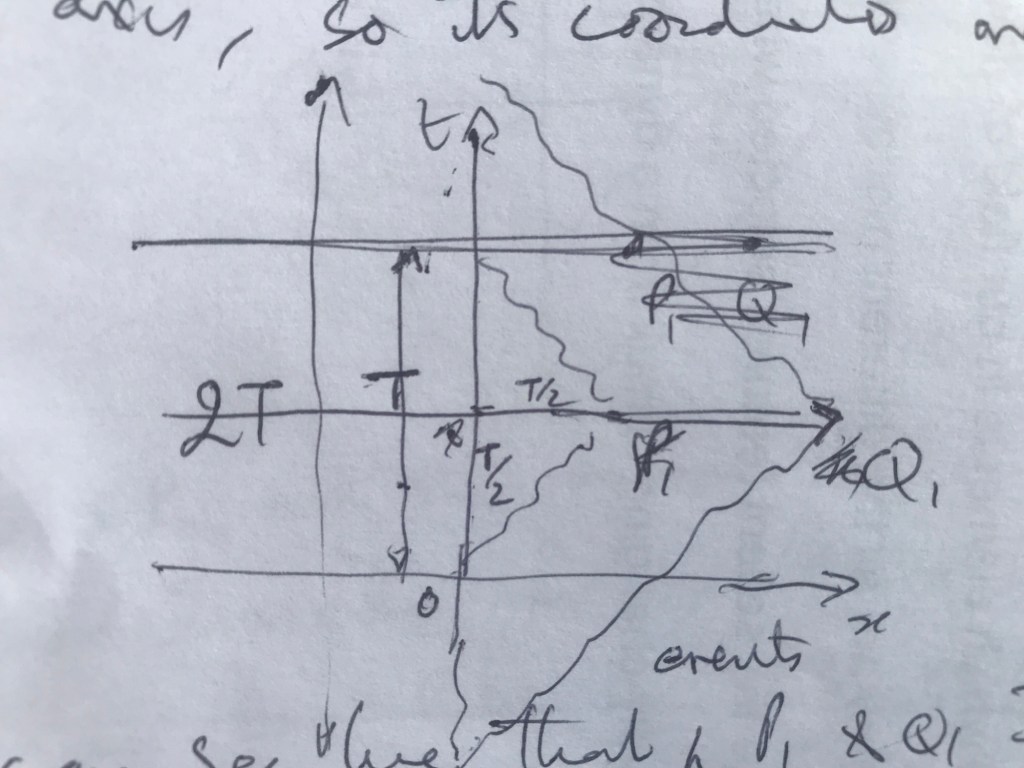
Note that the events at P1 and Q1 are simultaneous (for me) because the calculation for each gives the same t-coordinate, although Q1 is further away than P1; P1 is at (T/2, T/2) and Q1 is at (T/2, T), twice as far away (remember the t-coordinate is always the first coordinate mentioned).
My Line of Simultaneity – “LoS”
We can see from the foregoing diagrams that any events connected by a line parallel to the x-axis are simultaneous for me: the x-axis and any line parallel to it is a Line of Simultaneity, “LoS“, for me.
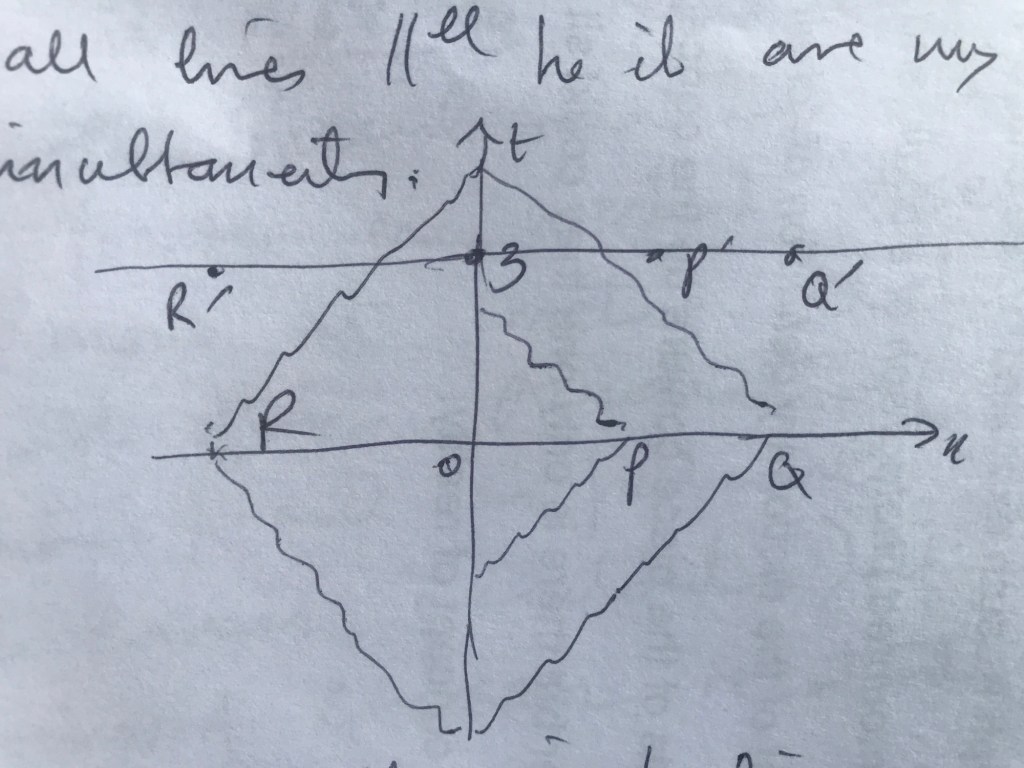
P, Q and R on the x-axis all lie on a LoS for me, but any line parallel to the x-axis, such as t=3, is also a LoS for me, connecting events P’, Q’ and R’, which are simultaneous for me.
Each LoS can be constructed using light beams (and reflected light beams) to establish that any points on the LoS are simultaneous for me, just as are P, Q and R, or P’, Q’ and R’ above.
Someone else’s Line of Simultaneity (LoS)
Now we turn to a crucial construction: the lines of simultaneity (LoS) for another observer moving relative to me.
At this point, I should emphasise that Special Relativity focuses on “inertial” observers, who move at constant relative speed to each other. Acceleration (changing velocity) and, in particular, gravity (that causes acceleration), are the province of General Relativity, which deals with “curved space” that corresponds with gravity, as per the John Wheeler quotation mentioned in the Introduction.
Einstein’s Special Relativity deals with “flat spacetime” – flat (Cartesian, not curved) space and “spacetime”, as illustrated here by our (t,x) coordinate diagrams for the time dimension and one space dimension.
In general, and for real space travel, we have to deal with time and three spatial dimensions (t, x, y, z). Still, for the purposes of this article, to explain simply the fundamentals of Special Relativity, we can deal more easily (and sufficiently) with one space dimension. We imagine we are on a straight railway track – a 1-dimensional world (plus time), just as in the opening diagram in the article.
Another Inertial Observer’s world line
Imagine another inertial observer, Bar, moving at constant speed v out of (say) Central Station in Glasgow at the Origin O of our 2D spacetime, on the rail track, having waved goodbye to me (Abel) as she left from O on the noon train.
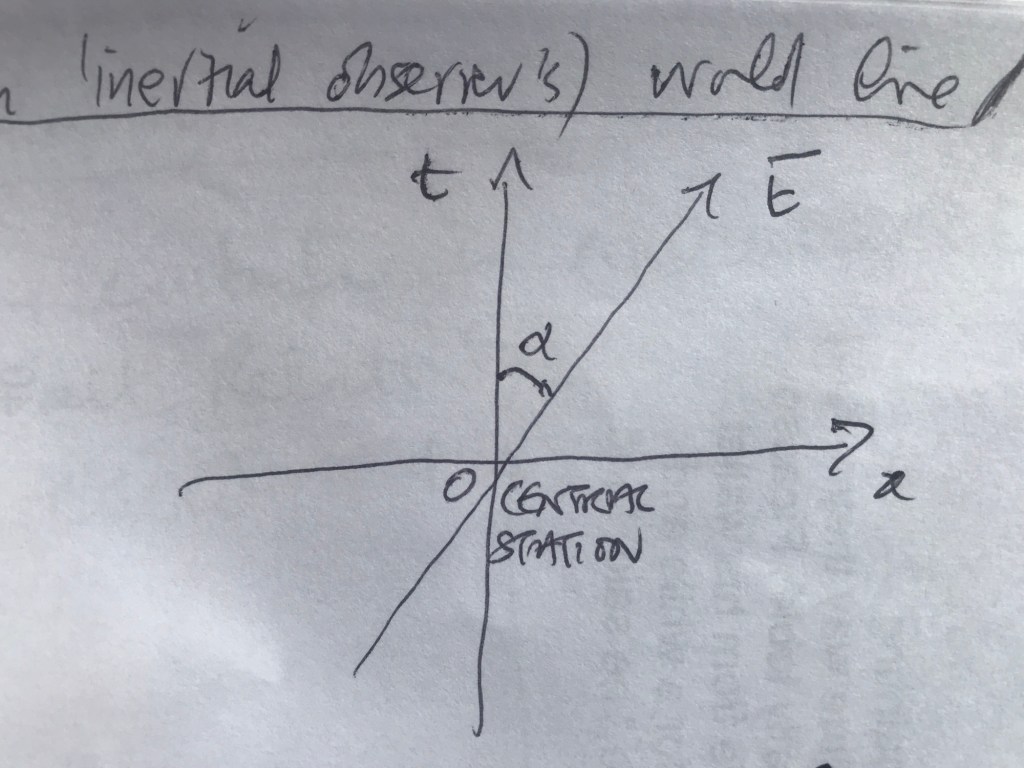
Her world-line is t̅ is shown in the diagram above. As time progresses for her, she moves along the railway track (which I see as my x-axis). Her world line t̅ might make an angle ⍺ with my own world line t in this diagram. The faster she travels, the greater the angle ⍺.
I remain sitting in Costa Coffee on the station concourse, so my own world line t remains defined as the vertical t-axis at x=0. The x-axis itself, as discussed before, is one of my lines of simultaneity, the first one.
What is Bar’s line of simultaneity?
This construction is absolutely fundamental to Special Relativity, because it relies upon, and emphasises the importance of the constancy of the speed of light for all observers.
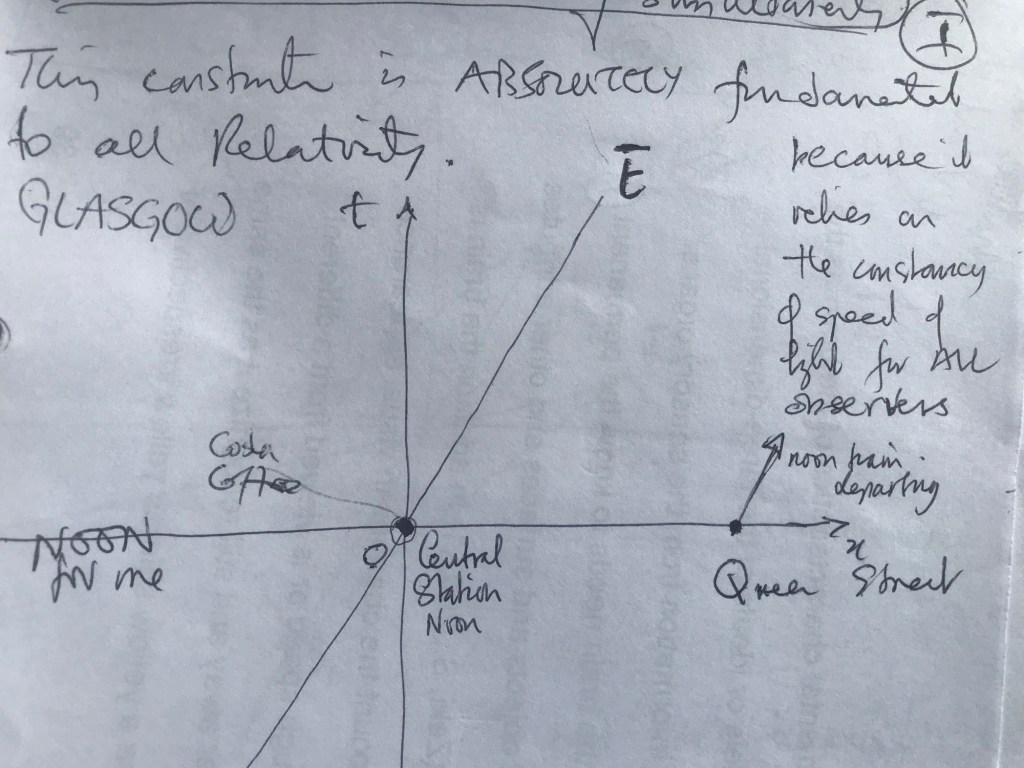
What events for Bar are simultaneous with O, Central Station at noon? For example, does she see the Queen Street (Glasgow’s other main terminus) noon train (on my clock) departing at noon as well?
Surprisingly, the answer is no, even though we both agree on the noon departure of her own train from Central Station, where we were both located at the moment of her departure.
Bar’s line of simultaneity for the Central noon train
To find Bar’s x¯-axis, we do exactly what we did for Abel’s (my) x-axis.
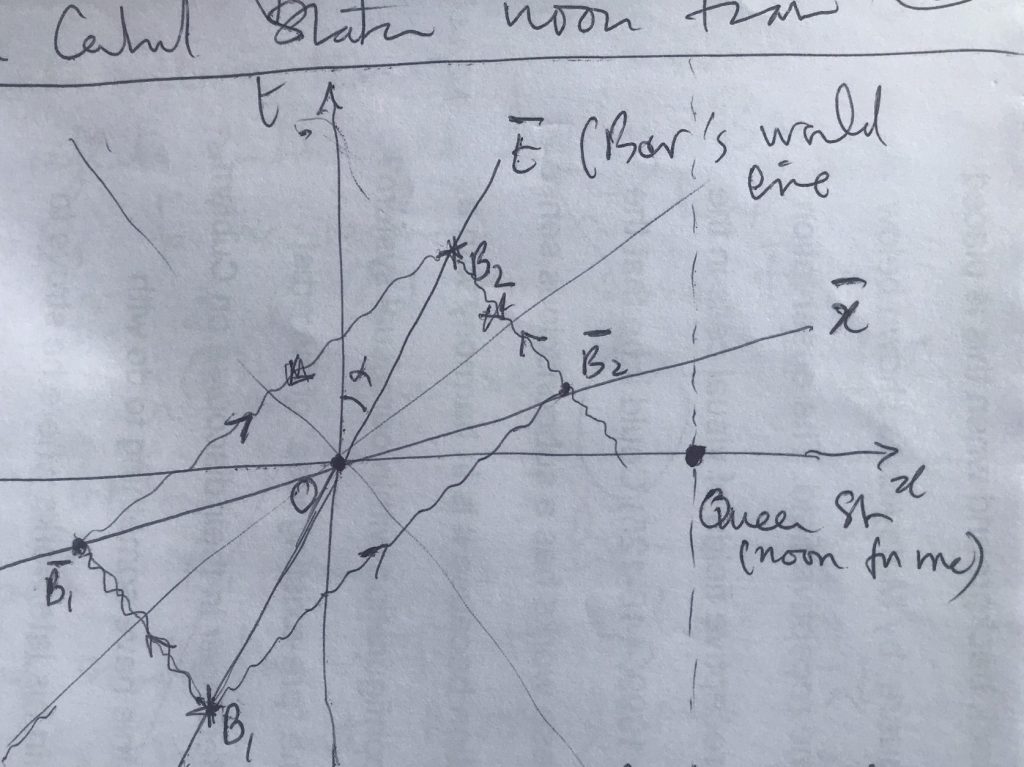
On Bar’s world line, t̅, she emits a light beam at B1 and receives reflected beams (from mirrors whose position we calculate to be at B¯1 and B¯2) back to B2 at equal times before and after her world line passes through Central Station. (It’s a terminus, so she must have walked there! She wouldn’t have taken Glasgow’s subway (known locally as the ‘clockwork orange’) as light beams wouldn’t reach her, being underground, from the main concourse, where Abel is located.)
These points on her world line are shown as B1 and B2, but any two points would do, as long as they are at equal times before and after noon (in Bar’s time) at Central Station.
The two barred points B¯1 and B¯2 are points we can construct, defined by postulating mirrors at those points that can reflect back the light sent by Bar from B1 to be received on her world line at B2, at the same time interval after noon as she sent them before noon.
By this construction, the points B¯1 and B¯2 lie on Bar’s line of simultaneity through Central Station (the Origin O), at noon, and that straight line is therefore her x¯-axis, as labelled in the diagram above.
You can see that Bar’s x¯ axis is not (as I see it from my world) perpendicular to her own world line t̅, and this is key to the so-called “paradoxes” of Special Relativity, Time Dilation and Length Contraction, as I will show later. The logic of those discussions, incidentally, will show that these aren’t paradoxes at all; they are part of the unavoidable logic of the main axiom of Special Relativity, that the speed of light is the same for all observers.
Don’t miss that Queen St train!
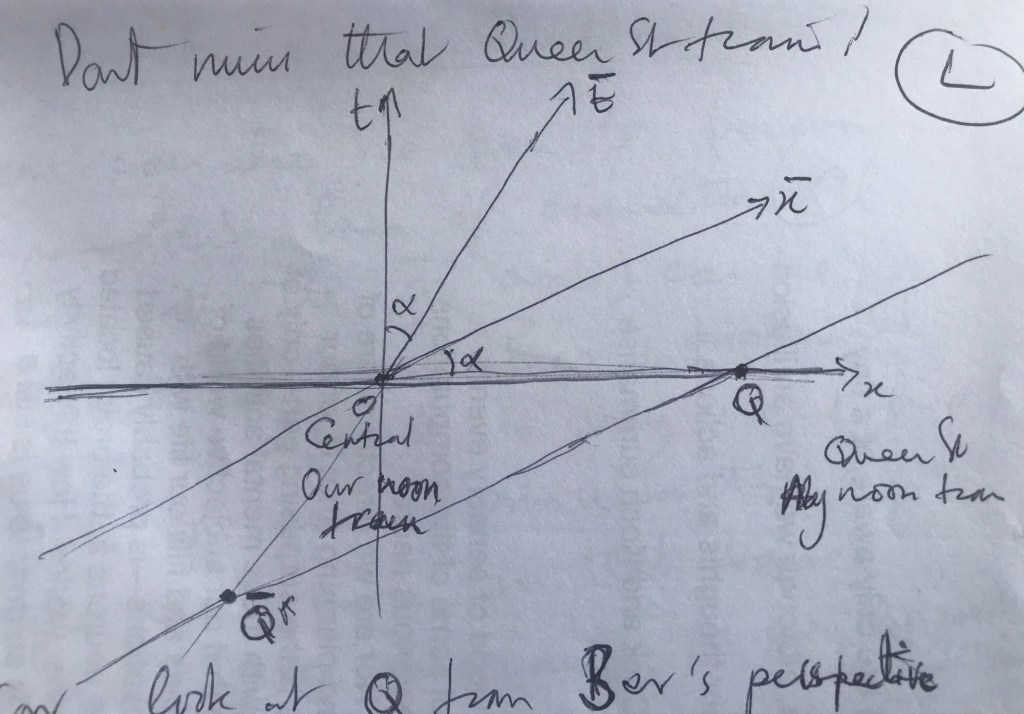
Look at Queen St station at Q from Bar’s perspective in the diagram above.
Her line of simultaneity (LoS) through Q, parallel to x¯, cuts her timeline t̅ before she reaches Central Station (i.e. on the negative t̅-axis). It is not surprising that Bar carried on to Central Station, because she would have missed the noon Queen St train (in my timeframe), because in her timeframe t̅, it left before noon.
Bar and I agree on the time of the noon train at Central Station, because we were both there at the same time, but we disagree on the time of the train from Queen St, because a) we were not there at the same time, and b) Bar is moving at a non-zero relative speed to me.
Constructing Lines of Simultaneity LoS
You can also see from the previous diagram that any LoS for Bar (starting with her x¯-axis) can easily be drawn; if Bar’s world line t̅ is at an angle ⍺ to mine (t), then her axis of simultaneity x¯ must be at an angle ⍺ to mine (my x-axis), in that same quadrant of the diagram. Every LoS for Bar is a line parallel to her x¯-axis.
Remember that the angle ⍺ must be less than 45º (π/4 radians) because nothing in Special Relativity theory can travel faster than light, which travels on those light cones we discussed, whose surfaces are at 45° to the x-axis (and to the t-axis).
In our daily human world, speeds are far less than a substantial fraction of the speed of light. We might call them “Newtonian” speeds. This means that our real-life measurements of t and t̅ are very nearly coincident, with ⍺ extremely small differences, and everyone tends to agree on train times at any station, wherever we are – fortunately – and therefore we don’t usually miss our connections.
Let’s now see how ⍺ relates to Bar’s relative velocity to me, v, using Hermann Bondi’s k-calculus.
Hermann Bondi’s k-calculus
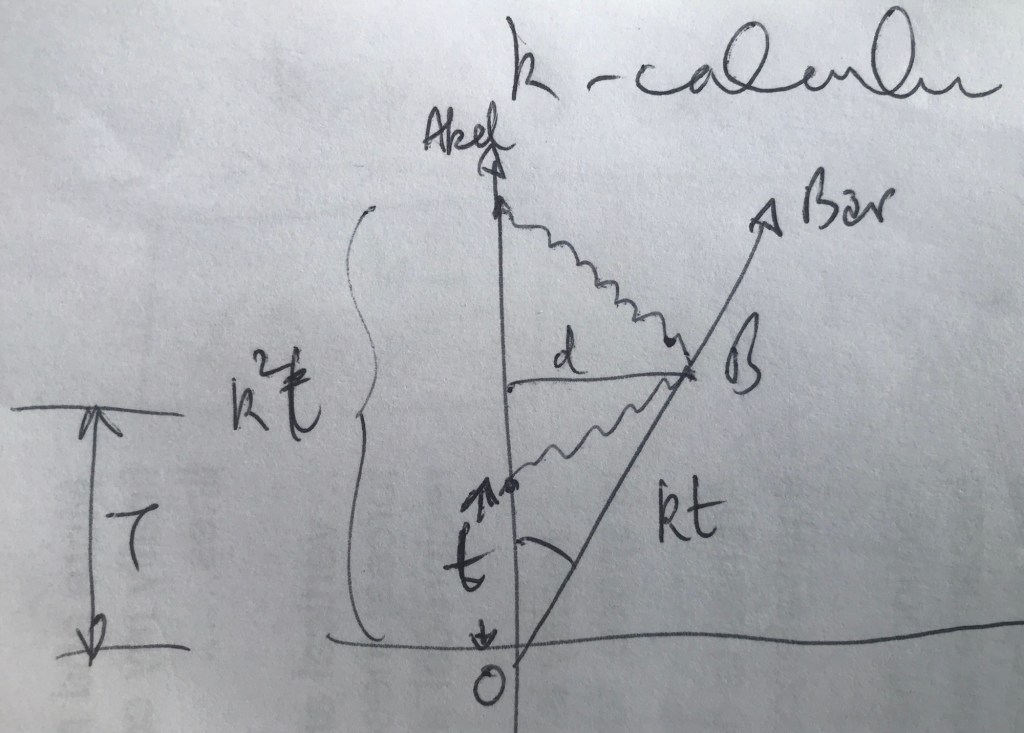
Assuming constant relative speed v of Bar to Abel involved in this analysis, it is reasonable to observe that the time on Bar’s world line OB is in a constant ratio to the time t measured by the originator of the light beam, Abel. Let’s call that ratio k.
From the diagram, we can see that Abel measures the time taken for the light beam’s one-way trip to Bar as half of the difference between the time of emission and the time of reception of the return signal. The elapsed time
(k2t – t)/2 = t* (k2 – 1)/2 = d, say.
And, since light speed c = 1, in our units, this is also the distance to Bar when she receives the light signal, which is why I have called it d.
The time that Bar receives the light signal, T, measured by Abel, is
T = t + (k2 – 1)t/2 = (k2 + 1)t/2.
Bar’s speed, therefore, measured by Abel, is
v = d/T = {(k2 + 1)t/2}/{t* (k2 – 1)/2} = (k2 – 1)/(k2 + 1).
We can now express k in terms of v, the relative speed between Bar and Abel. Multiplying out the equation above, we find
k2v + v = k2 – 1, or k2(1-v) = v+1,
And rearranging, we find
k = √{(1+v)/(1-v)}.
This is the ratio of time measured by Bar to the time measured by Abel. From this equation, we see that if v = 0 (Bar remains at the same place as Abel, then k = ±1 (which are both the square root of 1).
We can see from the definition of k in the diagram that if k>1, v is positive, and if k <1, v is negative. We also see from the definition of k in terms of v that if v –> –v, then k –> 1/k.
Composition rule of k factors
Let’s call the k-factor between Abel and Bar kAB, and suppose there is an additional observer, Charlie, travelling at relative speed to Bar, with k-factor kBC between Charlie and Bar, as shown in the diagram below.
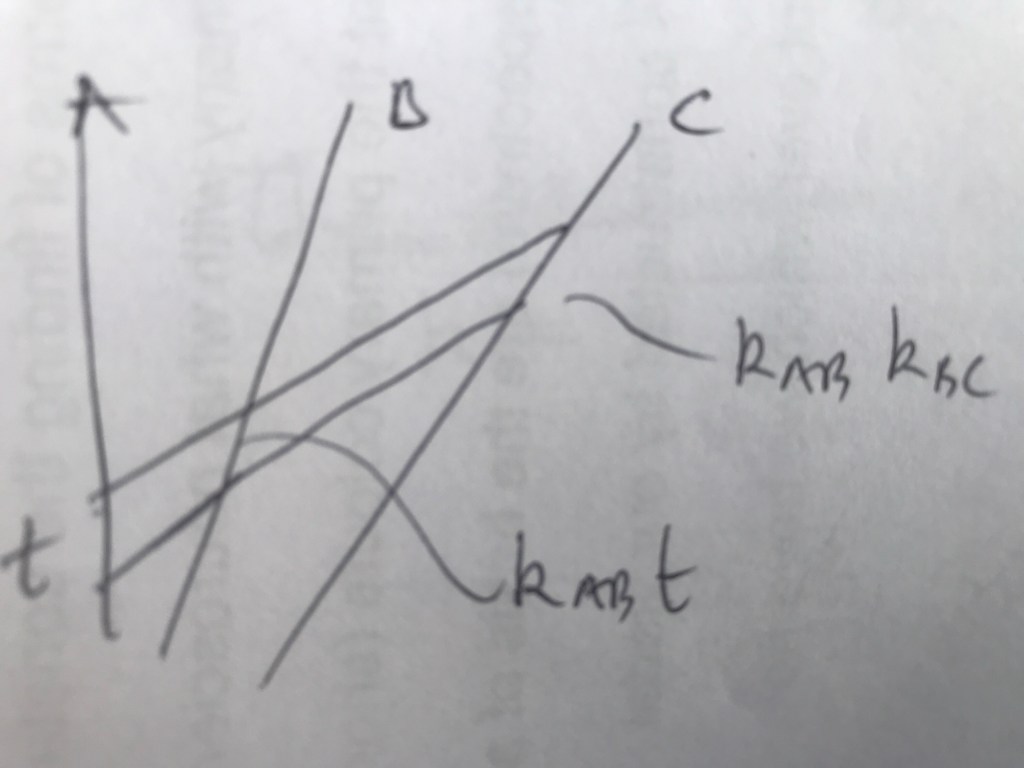
If t and t̅ are related by t̅ = kABt, and Charlie’s time t̅¯ = kBCt̅, then clearly the k-factor kAC between Abel and Charlie is
kAC = kAB x kBC.
A numerical example
Let us try some sample values for v, k, t, t̅ and ⍺.
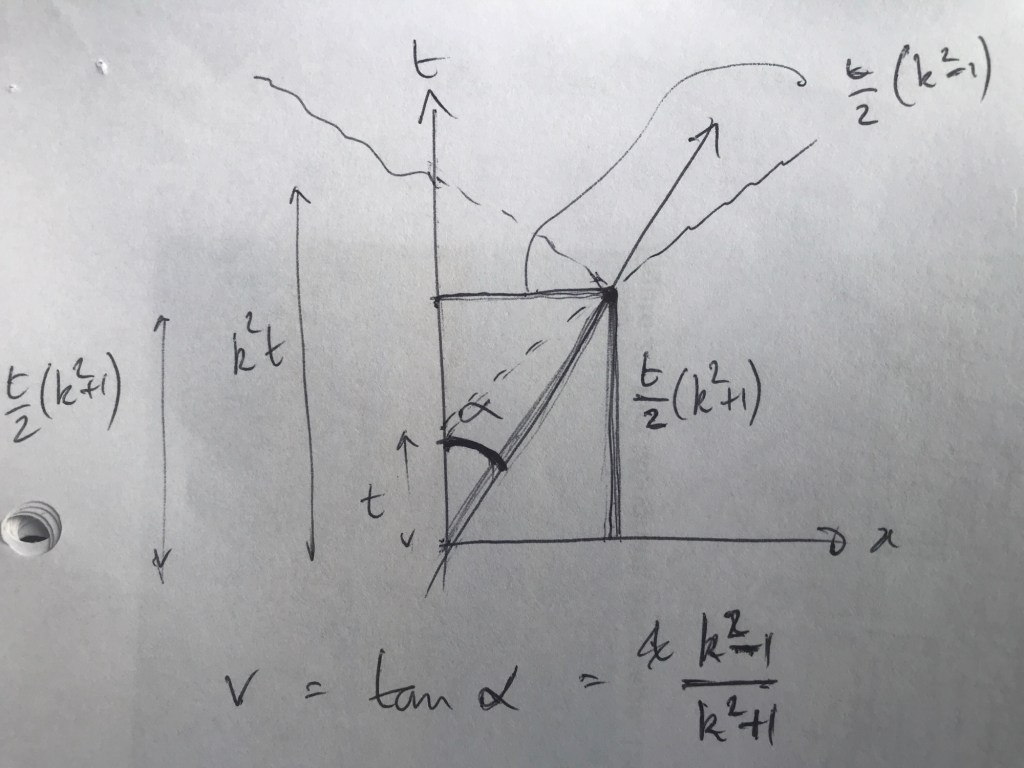
In this diagram, from the right-angled triangle where ⍺ appears, we can relate ⍺ and v, where v is equal to the distance Bar travels in unit time:
v = tan(⍺) = (k2 -1)/(k2+1).
Note that if ⍺ = 0, k = 1, since ⍺ = 0 means that Bar remains at Central Station with Abel (maybe sipping coffee with me in Costa Coffee!).
But, if, say, ⍺ = 30º, then tan(⍺) = 1/√3 = v. With this value of v,
k = √{(1+v)/(1-v)} = √(2.732/0.732) = 1.9, approximately.
So, for this value of k, if a year (t) passes for Abel, and, as before, t̅ = kt years pass for Bar, about 1.9 years.
This is an example of the “space traveller” twin paradox; that a space traveller, if they can travel at a significant fraction of the speed of light, c, which we call a relativistic speed, such as v = 1/√3, or about 0.577 of the speed of light, a space traveller Bar ages nearly 2 years, while her twin back on Earth, Abel, only ages 1 year.
Another view of how the line of simultaneity relates to v and ⍺
Consider t̅ = 7 years this time.
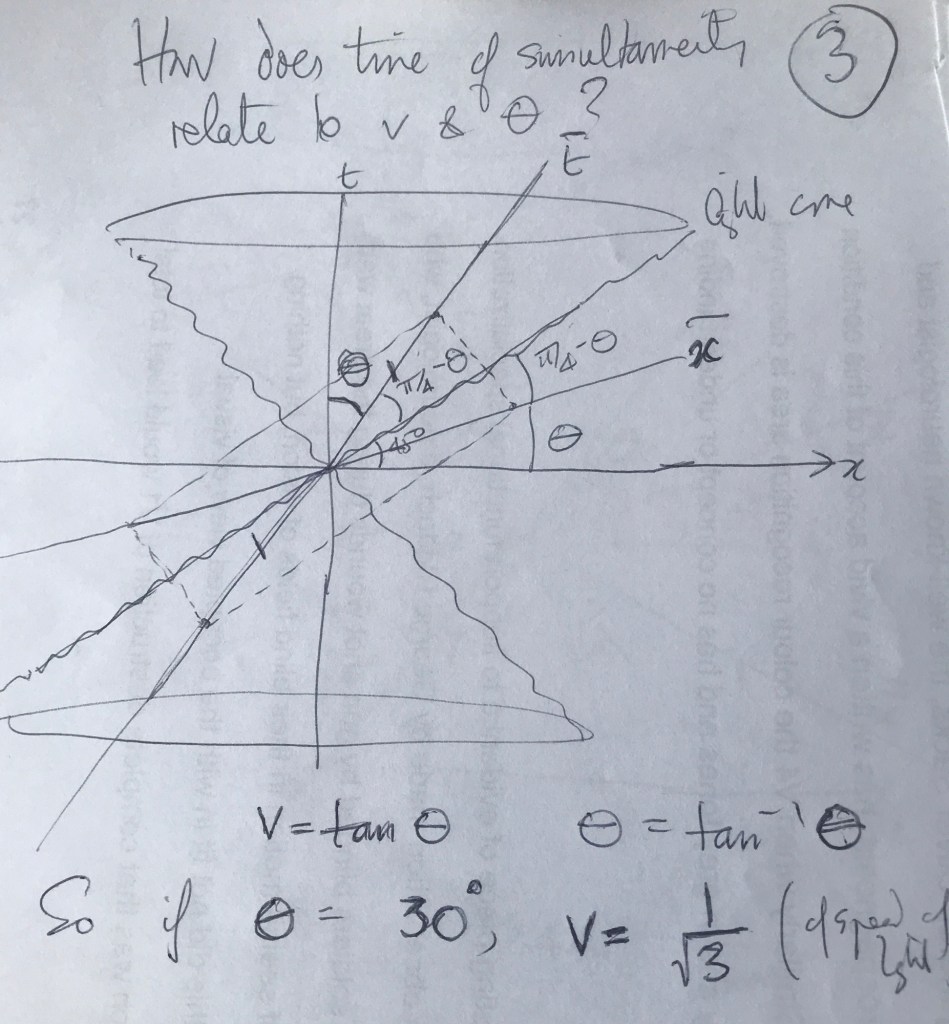
We see from the diagram above that if Bar travels at a speed v = tan(𝝷), (such that our previous ⍺ = 𝝷), then Abel sees the angle between Bar’s x¯ and t̅ axes as 90º minus 2𝝷, or (π/4 – 2𝝷).
Remember that the maximum speed of anything, or anyone, is less than the speed of light, which travels on the light cone at 45º (π/4) to the (t,x) axes in whoever’s time frame we are considering. If someone travels at just under the speed of light, their x and t axes as Abel sees them are virtually coincident, with 𝝷 just under 45º, or π/4 radians.
This also means that the light cone, the invariant in any observer’s space-time, must bisect the angle between any observer’s t and x axes, so that the speed of light measures the same in anyone’s coordinates. The faster the observer travels, the narrower the angle between your t and x axes.
Space traveller “paradox” continued
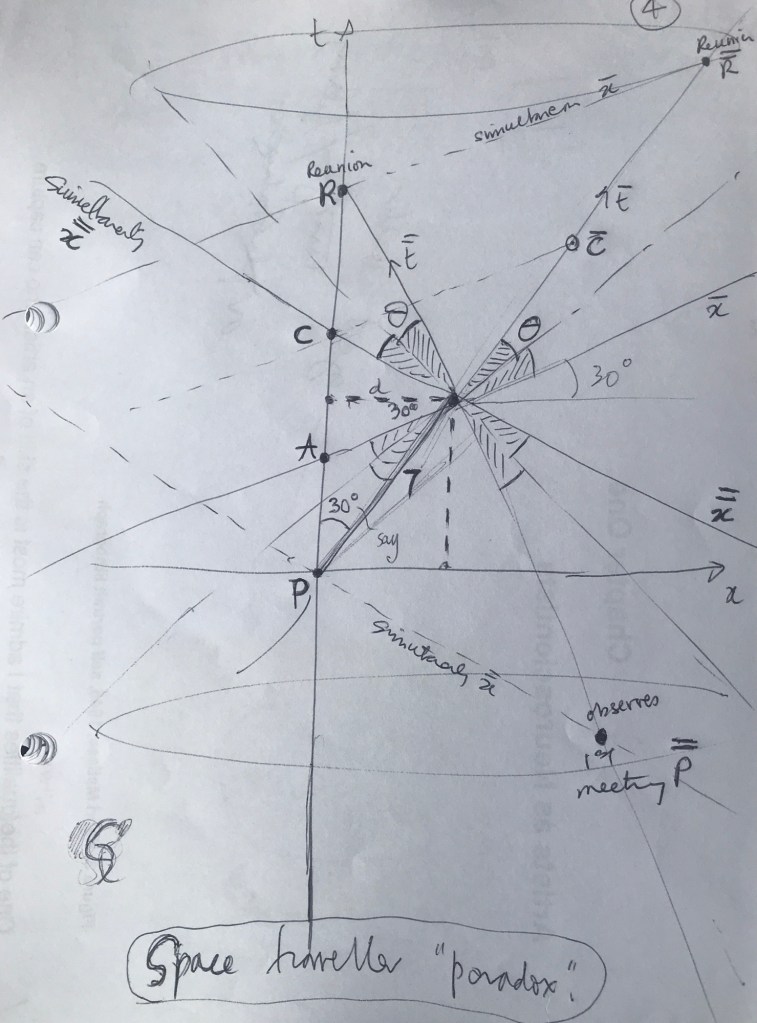
This time, in the diagram, we set t̅ = 7 years, and ⍺ = 30º as before. This value ⍺ again sets tan(⍺) = 1/√3 = v = 0.577 of the speed of light, c (which has the value c = 1 in our units).
This time, we have arranged with Bar to travel away from Earth for 7 years on her clock, and then to turn back and make the return journey to Earth at the same speed, also taking 7 years.
The angle 2ϴ in the diagram is the angle, as Abel sees it, between Bar’s x¯ and t̅ axes, which is not 90º (π/2 radians) as it is for Abel’s own space-time axes, as explained above.
Bar’s lines of simultaneity on her outward journey are the x¯-axis and lines parallel to it.
The other “double-barred” axes shown in the diagram are the (x¯¯, t̅¯) axes corresponding to Bar’s return trip, starting after being on her outward space journey for 7 years.
Construction of (t, x) frame simultaneity
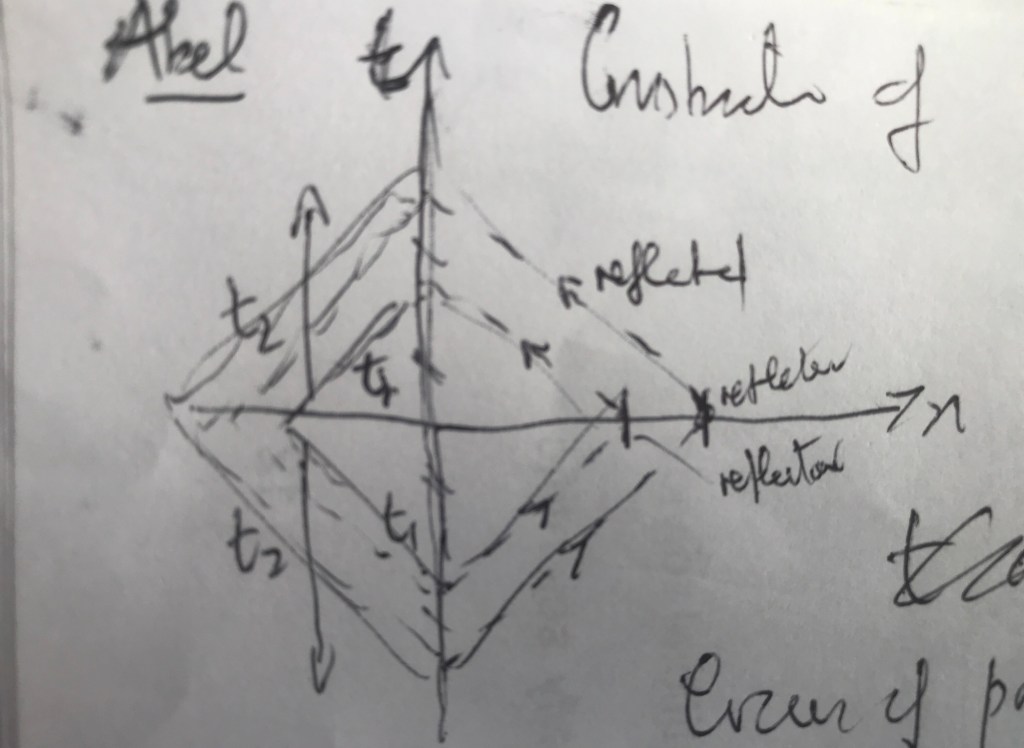
The x-axis is the locus of points of the light beam received from Abel and reflected back to Abel.
Now we construct the line of simultaneity for Bar, her x¯ axis, corresponding to t̅, Bar’s world-line of her uniformly moving inertial motion.
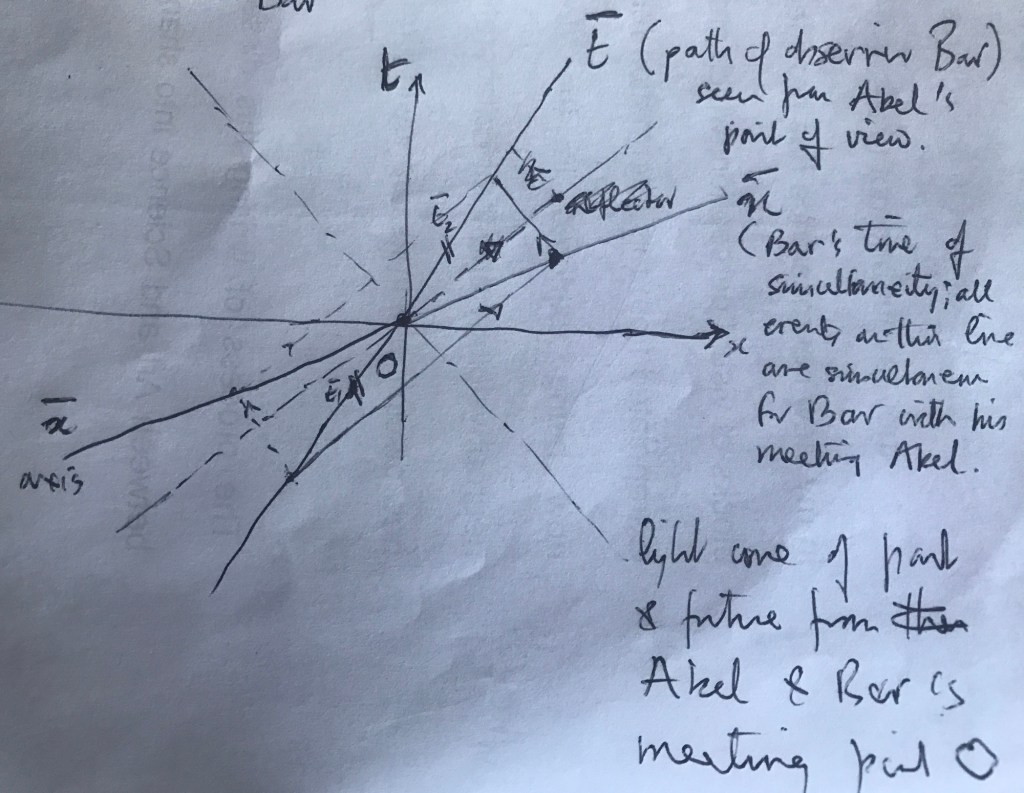
As before, we use light rays emitted by Bar from her world line towards Abel, at equal intervals before and after meeting him at the origin O, in both directions from her light cone at those points. As we see, Bar’s line of simultaneity, x¯, is distinct from Abel’s; all events on Bar’s LoS are simultaneous for Bar with her meeting with Abel at O.
Disagreement on Simultaneity between Abel and Bar
How does Bar perceive events that are simultaneous for Abel?
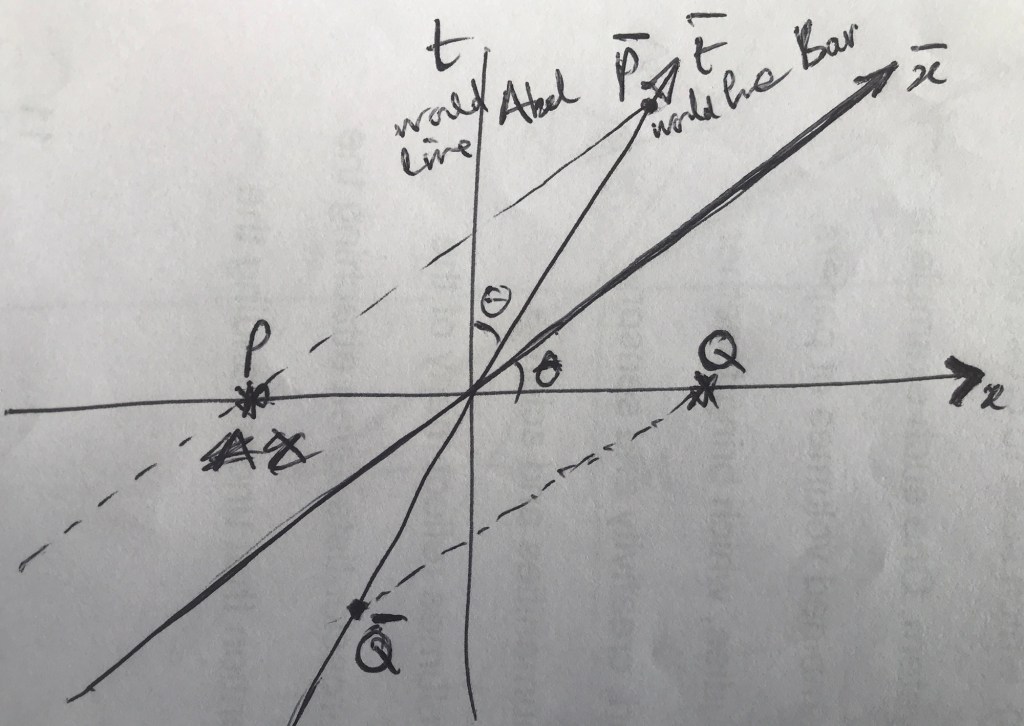
Events P and Q are simultaneous for Abel, but Q happens before P for Bar.
P and Q are said to be “spacelike separated”, meaning that no light beam (or observer) can travel between the two events. An observer who travels through P (or Q) cannot observe what happens at Q (or P), respectively.
**Q͞ and P͞ are the times at which Bar sees the events Q and P happen; these are, as we see, different from Abel’s perception of the events and their timing; Bar sees them happen at times Q͞ before (for Q) and P͞ after (for P) Abel sees them at Q and P respectively.
How does Abel perceive events that are simultaneous for Bar?
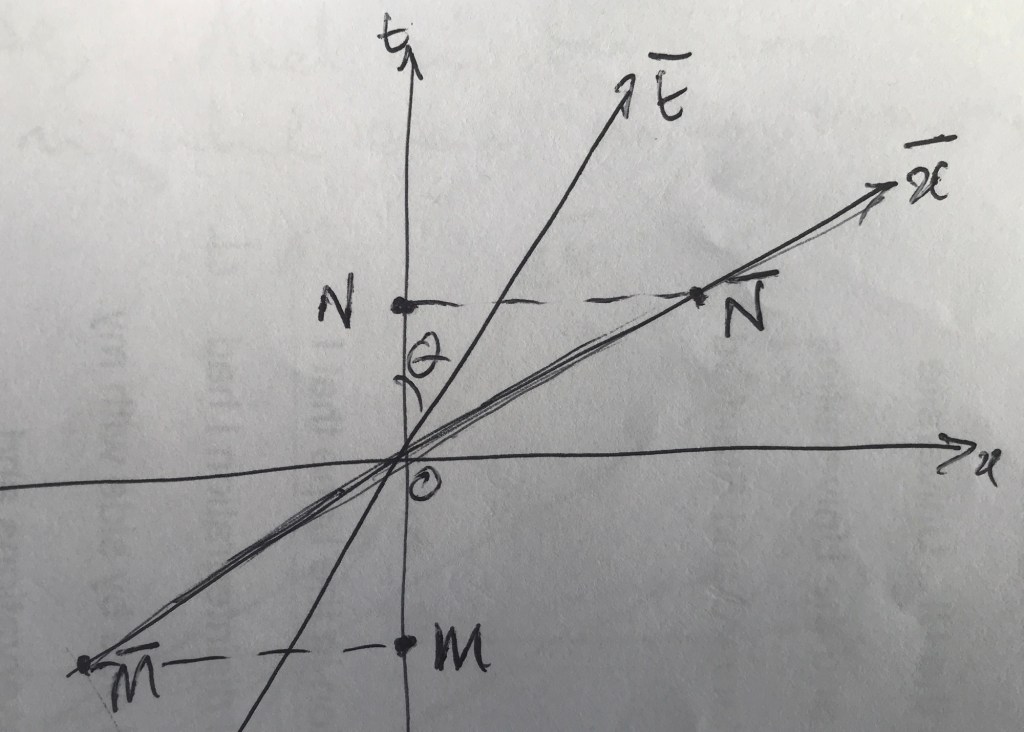
Conversely, events M͞ and N͞ are simultaneous for Bar, but Abel sees M͞ happen before N͞ – M and N are Abel’s view of when those events happen.
Events M͞ and N͞ are spacelike-separated for Bar, and for Abel and all other observers. An observer travelling through M͞ (N͞) cannot see what happens at N͞ (M͞ ), respectively, because M͞ and N͞ are not within each other’s light cones, which is also the case for the pair P and Q that we discussed before.
Even worse, Abel and Bar can disagree on which of two events might happen first.
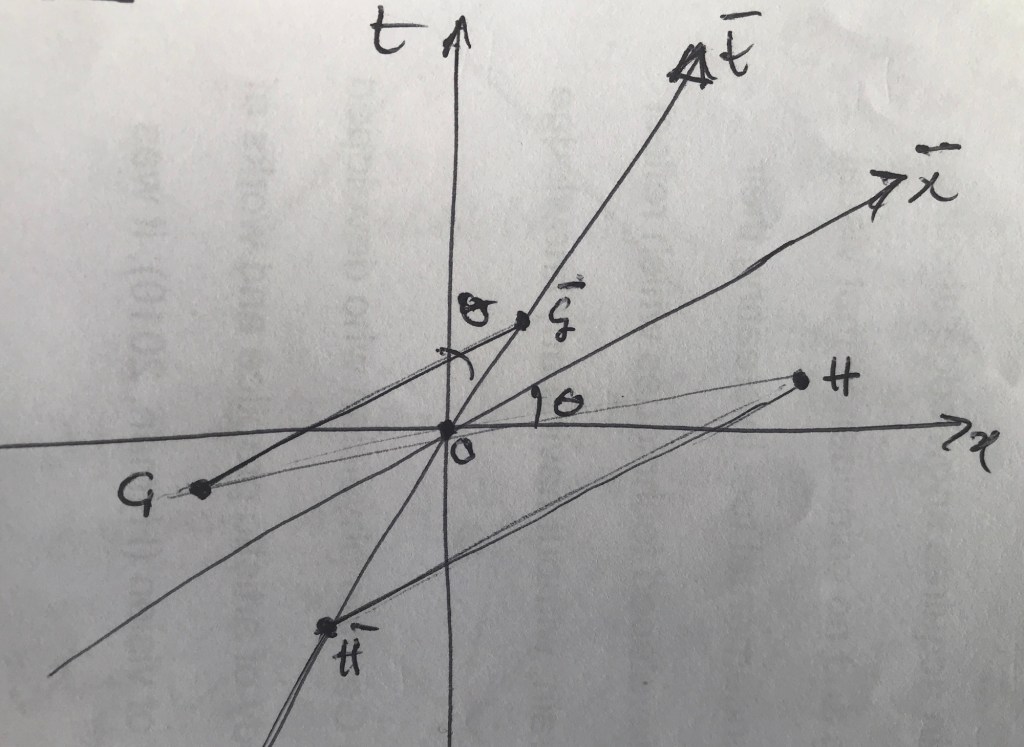
For Abel, event G happens before H; Bar, however, sees H happen before G, at H͞ and G͞ respectively on her timeline, points that we identify by using light beams from G (as Abel sees it) to G͞ on Bar’s timeline, and from H (as Abel sees it) to H͞ on Bar’s timeline.
NB For Abel, G & H are spacelike separated. We will see in the next sections that for two events with timelike separation (i.e. a light ray can travel between them), all observers must agree on their order. For spacelike separation, they can disagree, as we have seen.
Absolute & Relative past & future
We have looked at agreement and disagreement about simultaneity of events, and now we consider how and why observers might agree or not about what is in their past and future, not just about simultaneous events. What relationship between the observers might influence those perceptions?
Absolute past and future
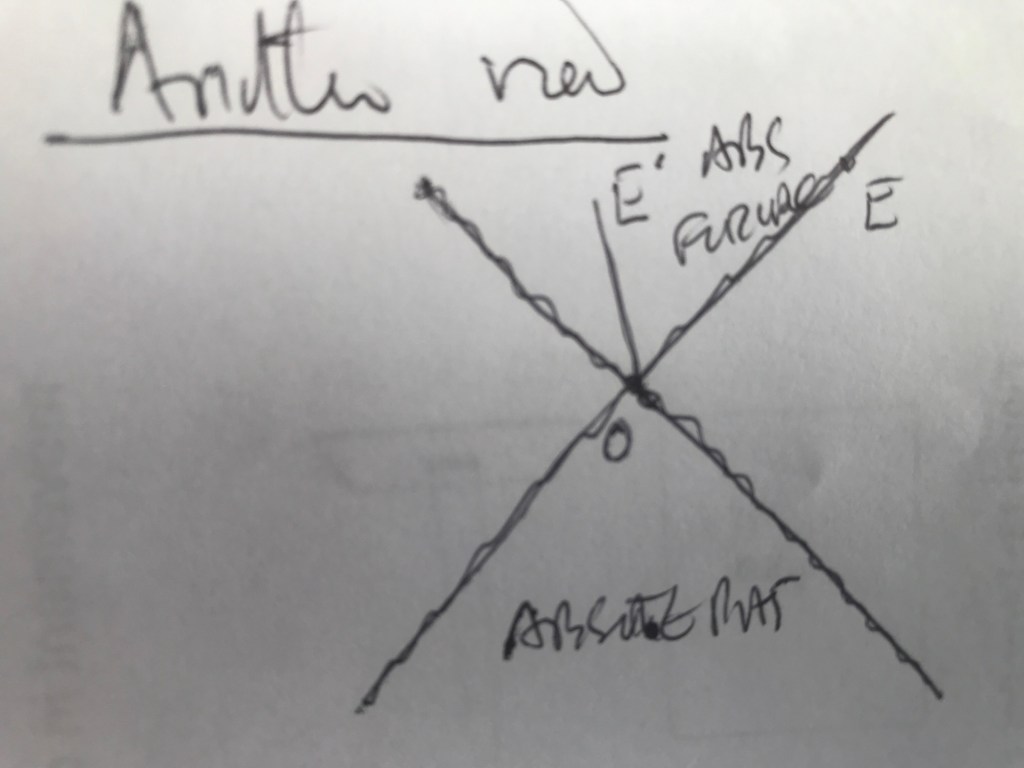
All observers agree that event E on the forward light cone occurs after O, because they can see the torch pressed at O and the beam arrive at E. They will also agree on any event E’ inside the forward light cone at O. The sequencing of breakfast at O and lunch at E’ is observable by all observers, even if the duration between them is different for different observers.
Relative past and future
Now look at events outside the light cone at O, and consider the event H.
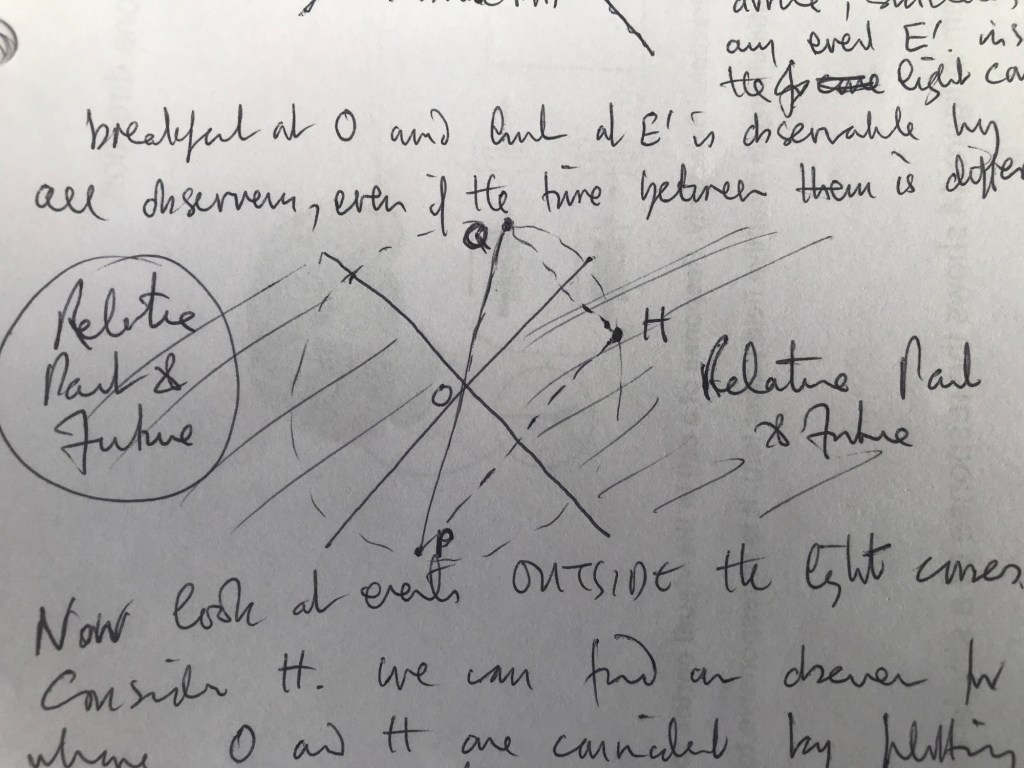
We can find an observer for whom O and H are coincident by plotting light rays at right angles (backwards and forwards) from H. Such an observer is one whose timeline is the line P–>Q, seeing H as coincident with O; light emissions and receptions occur equally on either side of O; H is on the observer P–>Q‘s line of simultaneity.
Timelike and Spacelike separation
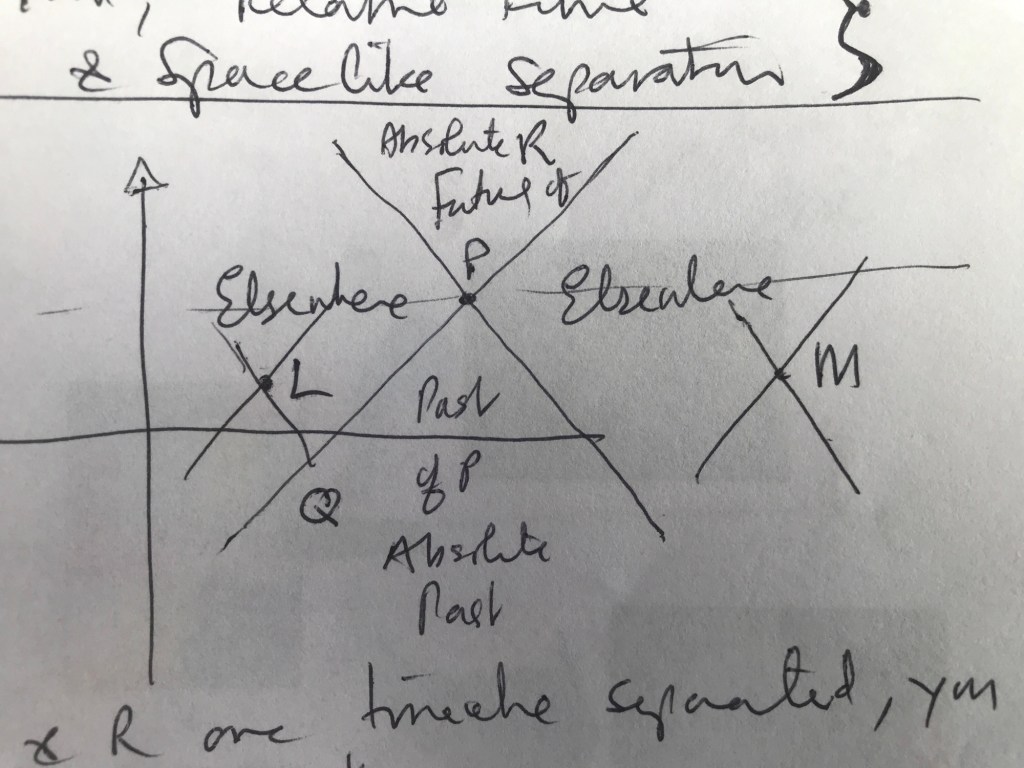
The two events Q and R are timelike separated; an observer could travel between them, i.e. an observer can make the journey between Q and R at a speed less than the speed of light.
The two events L and M are spacelike separated, and an observer cannot travel between them; they are in each other’s “elsewhere”.
Because of this dichotomy between timelike and spacelike separation, we can also understand that some observers can see events that others cannot. Some experiments, therefore, are not decidable by all observers; and, as we have seen, observers can even disagree on the sequence of events they can both see.
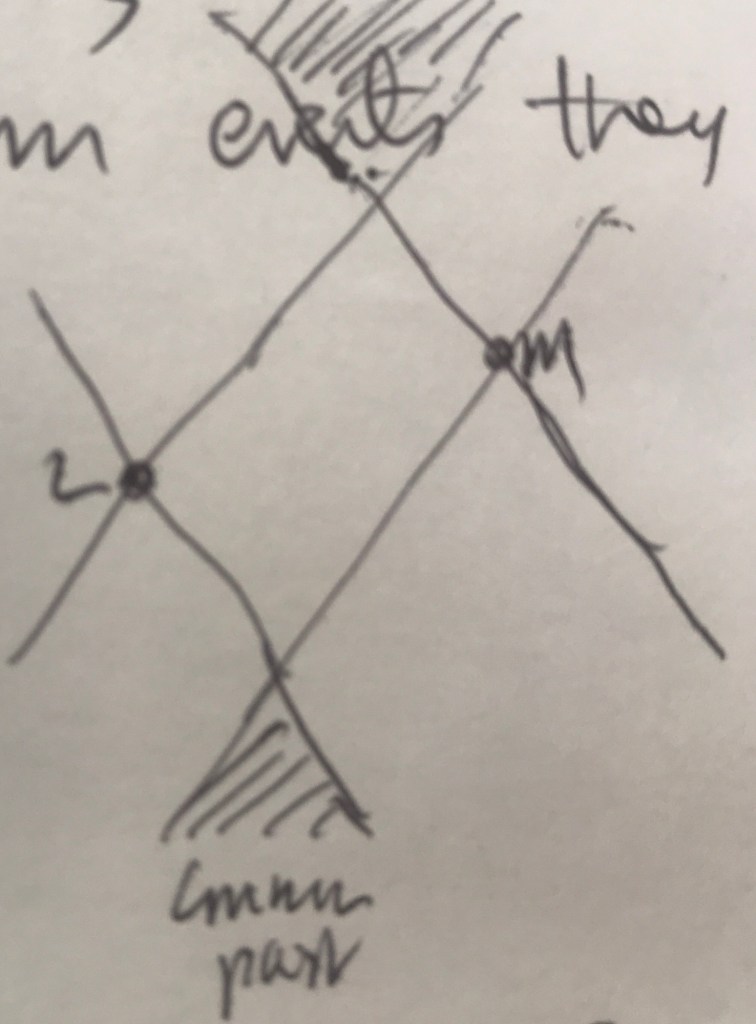
Observers at L and M have some common future and common past they can both see in the shaded overlaps between the areas within their respective light cones. They have no common view of any events in the unshaded areas.
Timelike separation
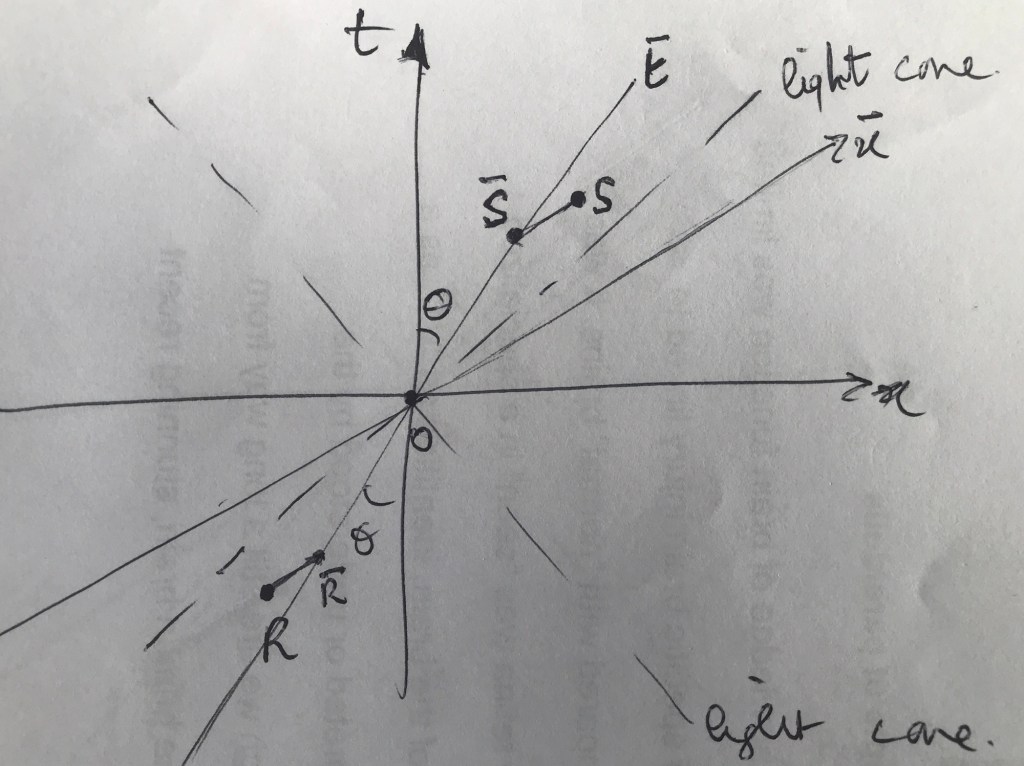
Events at R and S have timelike separation for Abel, with R happening before S.
Bar also sees that the first event R at R͞ happens after her view of S at S͞.
In general, there is no speed that Bar can attain that would change her perception of the order of the events R and S. The more slowly Bar travels relative to Abel, the more nearly her perception agrees with that of Abel. See the diagram below where Bar is travelling faster.
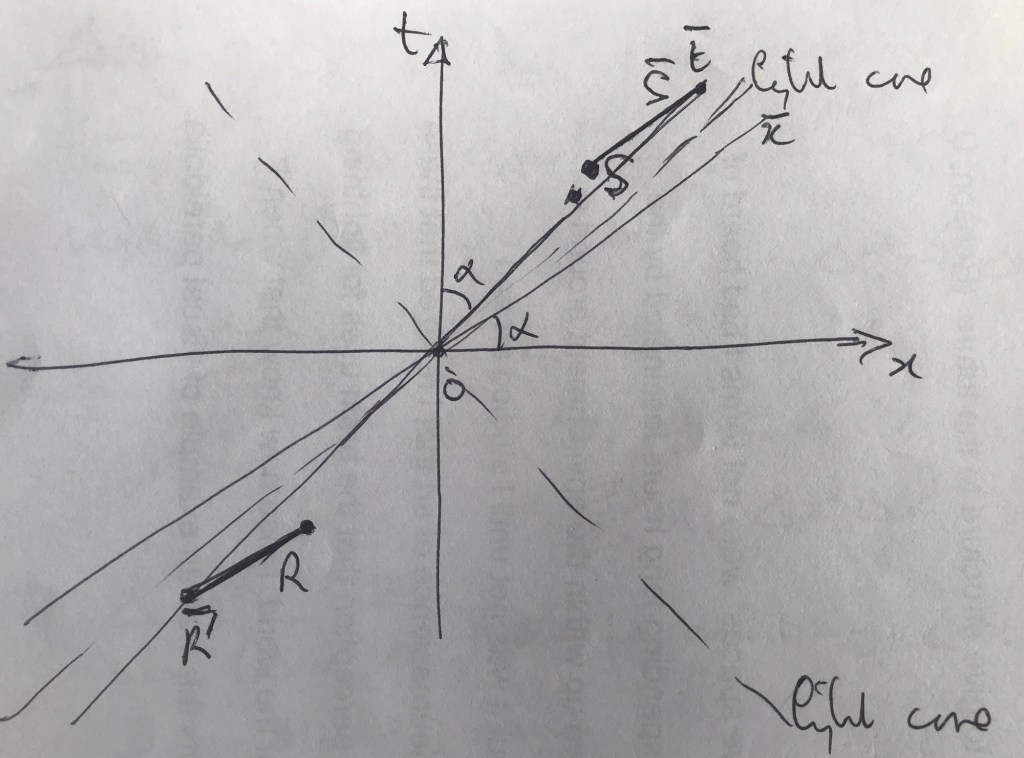
Events at R and S are timelike-separated for Abel, and this time, Bar is travelling faster relative to Abel than before. But we still have R͞ happening before S͞, in Bar’s view, so that Abel and Bar still agree on the sequence of events R and S. The faster that Bar moves relative to Abel, the greater the times she measures between the events R and S, approaching infinity as Bar’s relative speed to Abel’s speed approaches (but cannot reach, of course) the speed of light.
The Lorentz Transformation (via k-calculus)
The Lorenz transformation, named after the Dutch physicist Hendrik Lorenz, is the mathematical formula that allows us to transform time and distance between two inertial frames of reference, and is the mathematical description of all that we have been discussing so far.
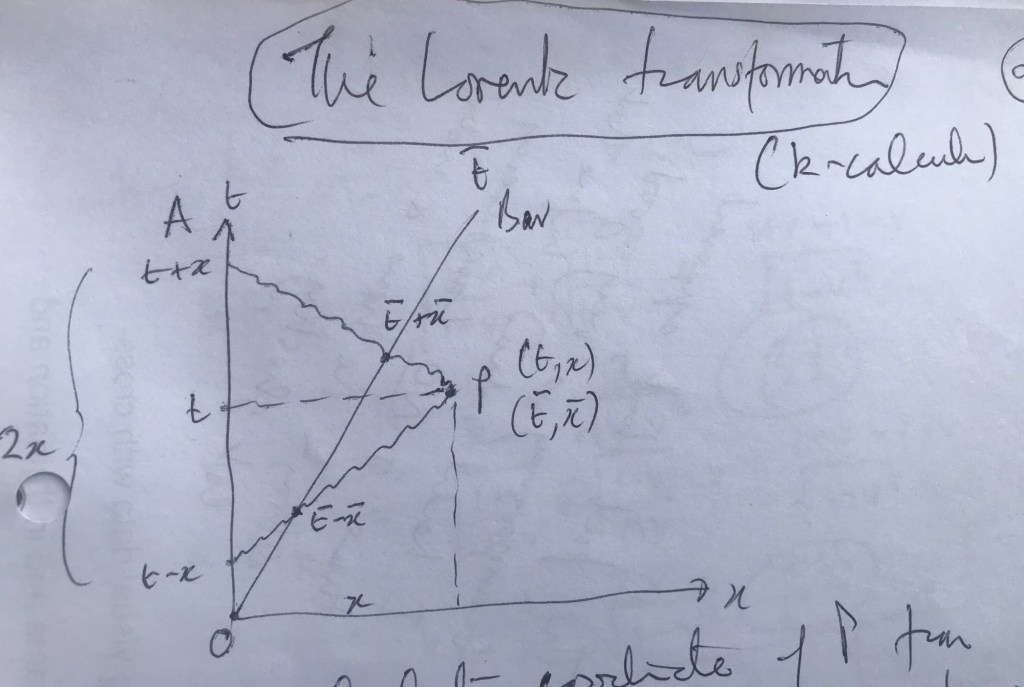
Let us calculate the coordinates of event P from the point of view of both Abel and Bar in their respective coordinate systems, (t, x) and ( t̅, x¯). Their clocks are synchronised when they were together at the Origin O. By our previous k-calculus,
t̅ –x¯ = k(t–x) (1)
t+x = k( t̅+x¯) (2)
or t̅ +x¯ = (1/k)(t+x) (2′)
Then adding (1) and (2′), we see that
t̅ = (1/2){kt –kx +(1/k)t + (1/k)x}, or
t̅ = (1/2)(k+(1/k)t – (1/2)(k-1/k)x, and (3)
x¯ = (1/2){(1/k)t +(1/k)x –kt +kx} or
x¯ = (1/2)(k + 1/k)x – (1/2)(k – 1/k)t (4)
Note, as a sanity check, that if k = 1 in the above equations (3) and (4), with no relative motion between Abel and Bar, then t̅=t and x¯=x, as they should.
Lorentz transformation in terms of relative speed v
In equations (3) and (4), we know from our previous work that k = √{(1+v)/(1-v)}, with v<1, as no one can reach the speed of light c = 1. So we can set
k + 1/k = √{(1+v)/1-v)} + √{(1-v)/1+v)}, or rearranging,
k+1/k = 2/√(1-v2) (β1)
and similarly
k-1/k = √{(1+v)/(1-v)} – √{(1-v)/(1+v)}, or
k-1/k = 2v/√(1-v2). (β2)
Substituting back into (3) and (4), we see
t̅ = t/√(1-v2) – vx/(1-v2) or
t̅ = (t–vx)/√(1-v2) (β3)
x¯ = x/√(1-v2) – vt/√(1-v2), or
x¯ = (x–vt)/√(1-v2) (β4)
and these are the Lorenz transformations from (t,x) spacetime into (t̅ , x¯) spacetime. Also note that from these equations, (β3) and (β4), it is easy to see that:
t̅2 – x¯2 = t2 – x2
so that spacetime distance d is invariant under Lorentz transformations, where in 3 space dimensions, d2 = t2 – (x2 + y2+ z2), the spacetime metric of distance.
Time Dilation
The term “time dilation” describes the effect that time travel progresses more slowly for a space traveller, Bar, compared with her twin, Abel, here on Earth, one of the two so-called paradoxes in Special Relativity, the other being length contraction, which I shall cover in the next section.
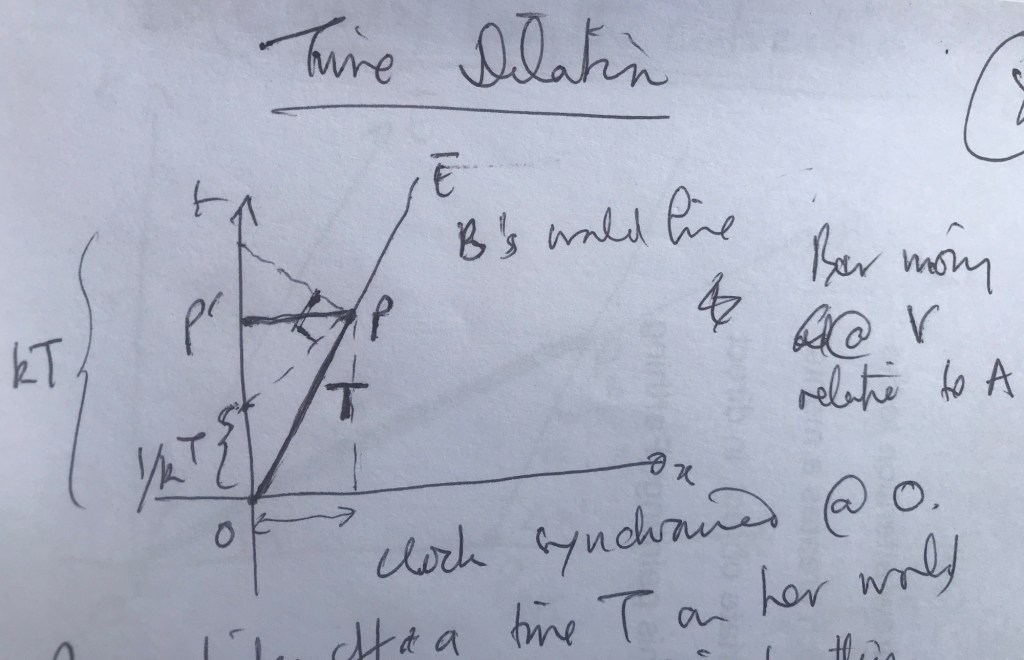
If Bar ticks off a time interval T on her world line to the event P, Abel will measure the time to P’ differently: by our (Bondi’s) k-calculus, P’ occurs at the time tP’, given by
tP’ = (1/k)T + (1/2){kT + (1/k)T} = (T/2)(k + 1/k).
But as we saw before in equation (β1) for the Lorentz transformation between Abel’s and Bar’s coordinates (or frames of reference), (k + 1/k) = 2/√(1-v2), and so
tP’ = T/√(1-v2)
Abel, therefore, measures the time interval T measured by Bar as larger, by a factor of 1/√(1-v2) (a number greater than 1) and the larger v, always less than the speed of light c = 1, remember, the greater the time measured by Abel compared with Bar.
If we revert to using “c” as the speed of light, rather than 1, this equation takes the familiar form
tP’ = T/√(1-v2/c2)
and so tP’ is always less than T for non-zero v. Our space traveller, Bar, comes back to Earth younger than us!
Length contraction
In the diagram below, OP is the “proper” length of a rod of length l, OP in Bar’s frame of reference, lying on Bar’s x-axis in her direction of motion. Proper length is the distance between two points measured in the same inertial frame where the object is at rest, Bar’s frame of reference in this instance, representing the maximum possible length in any possible frame of reference.
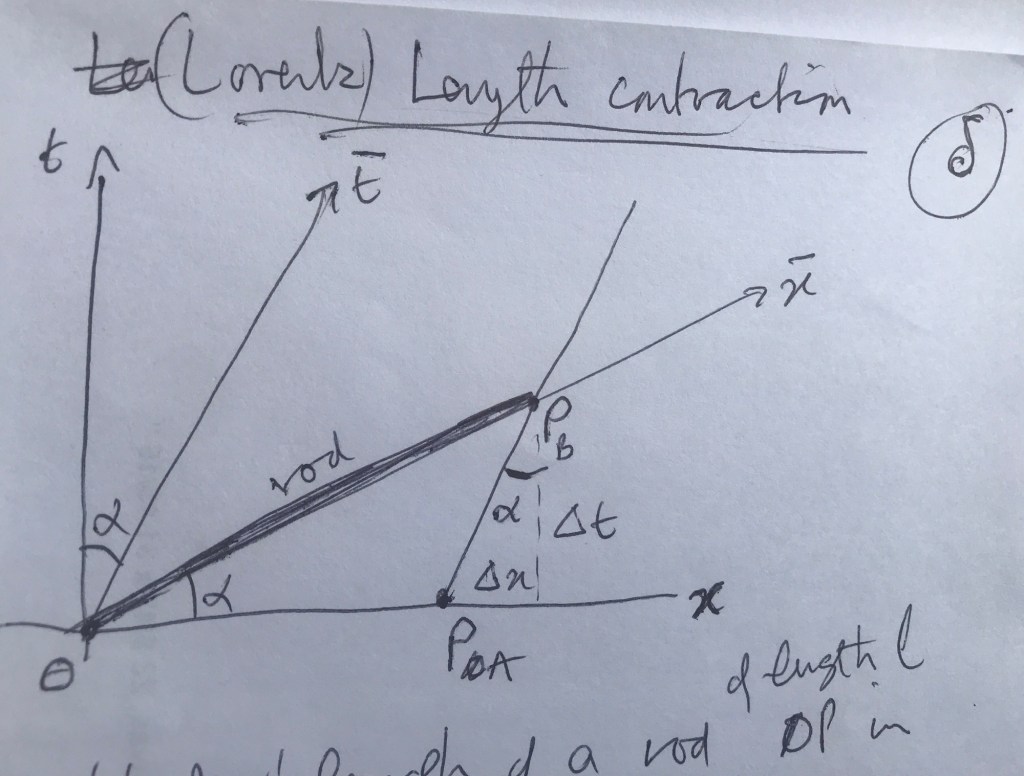
If the coordinates of the ends of the bar OP in Bar’s spacetime (t̅, x¯) are (0, l), then the coordinates in Abel’s spacetime, according to the Lorentz transformations, from (β3) and (β4) above, are:
tP = vl/√(1-v2),
with v negative from Bar’s viewpoint, and
xP = l/√(1-v2).
From the diagram, we see that
tan(⍺) = vl/√(1-v2).
But tan(⍺) = Δx/Δt = v, Bar’s speed, where Δx = xPB – xPA and Δt = (tPB – tPA).
Bar/s speed v is just the rate of change of the distance x¯ with respect to the time t̅, or
v = Δx/Δt, or
v = (xPB – xPA)/(tPB – tPA)
tPA = 0 at the origin of coordinates O, so this becomes
vtPB = xPB – xPA, or
xPA = xPB – vtPB
We can now substitute for xPB and vtPB from the earlier work and see that
xPA = l/√(1-v2) – v2l/√(1-v2) or
xPA = l√(1-v2).
xPA is the length of the moving rod as it appears in Abel’s x-axis.
In Einstein’s Theory of Special Relativity, Bar’s moving rod, of length l, appears shorter to Abel by a factor of √(1-v2) for speeds v between 0 and 1. If we revert to using “c” as the speed of light, rather than 1, this equation takes the familiar form
xPA = l√(1-v2/c2),
expressing Abel’s perception of the shortening of an object’s length dimension in Bar’s direction of motion.
Summary
The key features of Einstein’s Special Relativity have now been outlined. I have described contrasting perceptions of simultaneity, time and distance by inertial observers travelling at relative speed.
I hope I have shown that these contrasting perceptions are not paradoxes, but simply logical outcomes of the startling assumption that the speed of light is always observed as travelling at the same speed, no matter the speeds of the observers or the source of light.
That assumption, and its consequences, are the work of Einstein’s genius.
References
(1) Assumption and Myth in Physical Theory by Hermann Bondi, FRS, Cambridge University Press, 1967; The Tarner Lecture delivered at Cambridge in November 1965.
(2) Can Lorentz transformations be determined by the null Michelson-Morley result? (Podem as transformações de Lorentz ser determinadas pelo resultado nulo de Michelson-Morley?) by J. A. S. Lima1, Fernando D. Sasse∗2, received on November 19, 2016, accepted on January 11, 2017. 1 Departamento de Astronomia, Universidade de S˜ao Paulo, S˜ao Paulo, SP, Brazil. 2 Departamento de Matem´atica, Universidade do Estado de Santa Catarina, Joinville, SC, Brazil


One thought on “Understanding Einstein’s Special Relativity Physics”